

In this article
- Is it normal for toddlers to hit during this stage?
- Why toddlers hit
- What to do in the moment
- What to say when your toddler hits
- What not to do
- How to reduce hitting over time
- Is it normal for toddlers to hit parents more than others?
- When toddler hitting may need extra support
- If you’re feeling judged, you’re not alone
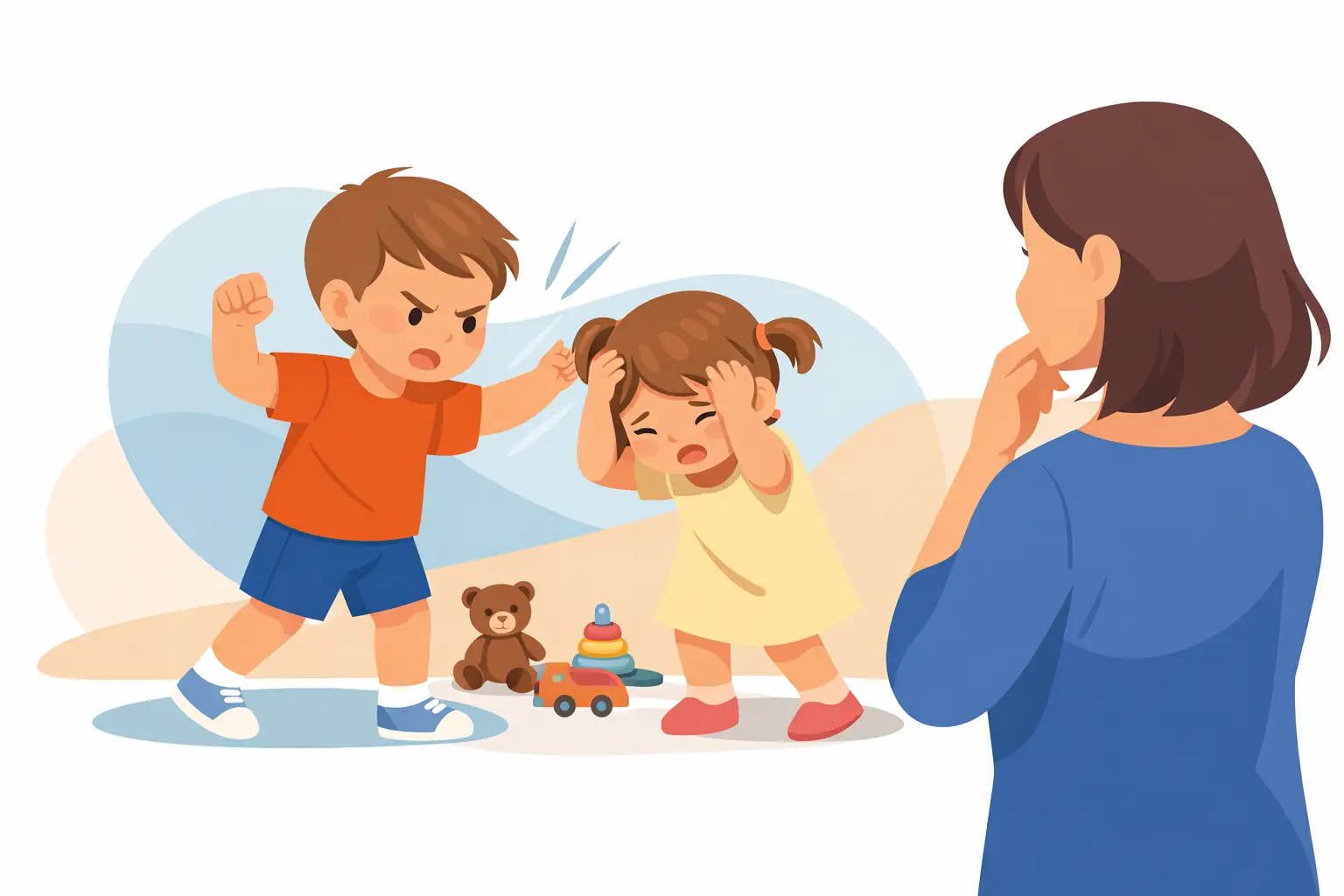
One minute your toddler is cuddled into your leg, and the next they’ve smacked you across the face because you cut their toast the wrong way. It’s jarring, embarrassing, and for many parents, oddly upsetting. If you’re wondering, is it normal for toddlers to hit, the short answer is yes. It’s common toddler behaviour, but that does not mean you should ignore it.
Toddlers hit because they’re still learning how to handle big feelings, body impulses, frustration, and social boundaries. Your job is not to panic or punish harshly. It’s to teach, calmly and repeatedly, that hitting is not OK and to show them what to do instead.
Is it normal for toddlers to hit during this stage?
Yes, for many toddlers, hitting is part of normal development. Common does not mean pleasant, and it definitely does not mean acceptable. But it does mean your child is not automatically “aggressive” or “naughty” because they lash out.
Toddlers are working with an unfinished set of skills. Their language is still developing, their impulse control is weak, and their ability to pause before acting is limited. They often feel things intensely and react physically before they can explain what’s going on.
That’s why hitting often shows up around the same time as other big toddler behaviours such as biting, throwing, shrieking, refusing, or melting down over tiny changes. They are not giving you a hard time. More often, they are having a hard time.
Why toddlers hit
Most toddler hitting falls into a few predictable buckets. Sometimes it’s frustration. They want the toy, the snack, the turn, or your attention, and they don’t yet have the words or patience to manage the delay.
Sometimes it’s sensory or impulsive. A toddler may hit almost as a reflex when excited, tired, overloaded, or dysregulated. Some even hit while playing because they do not fully understand force or how their actions affect others.
And sometimes it gets a reaction. If hitting instantly brings intense attention, even negative attention, toddlers may repeat it while they work out cause and effect.
There can also be situational triggers. Hunger, poor sleep, changes to routine, new childcare settings, a new sibling, or family stress can all make hitting more likely. This is where context matters. A toddler who hits more during pick-up time at nursery may be exhausted. A toddler who hits only at home may be releasing tension where they feel safest.
What to do in the moment
When your toddler hits, your response needs to be quick, clear, and boring. This is not the moment for a long lecture. They are not in a place to absorb one.
Start by stopping the action. Gently hold their hand if needed, move them back, and say something simple: “I won’t let you hit.” If they’ve hit another child, prioritise the child who was hurt first. That teaches your toddler that hurting someone shifts your attention to safety and repair, not drama.
Keep your voice calm and firm. You don’t need to shout to mean it. In fact, shouting can add more heat to an already overloaded moment.
Then name the limit and, if possible, the feeling. “You’re angry. You wanted the lorry. I won’t let you hit.” This helps join the dots between emotion and behaviour without excusing the behaviour.
After that, redirect to what they can do. “Hands down. Stomp your feet. Say ‘my turn’.” Toddlers need an alternative, not just a stop sign.
What to say when your toddler hits
Parents often freeze because they want the perfect response. You do not need perfect. You need consistent.
Simple scripts work best:
“Hands are not for hitting.”
“I won’t let you hit me.”
“You’re cross. Hitting hurts.”
“If you want help, say ‘help please’.”
“You can be angry. You cannot hit.”
If they’ve hurt someone, keep repair simple too. Depending on age, that might be: “Check if they’re OK,” “Bring the ice pack,” or “Let’s help.” A forced apology from a furious two-year-old usually means very little. Real repair matters more than a mumbled “sorry”.
What not to do
There are a few responses that tend to make toddler hitting worse.
Hitting back to “show them how it feels” is one of them. It teaches exactly the opposite of what you want. If your child is learning that people hit when upset, they’ll keep using hitting as a tool.
Long punishments usually miss the mark too. Toddlers do not connect a lengthy consequence with a split-second act in the same way older children do. The lesson gets lost.
Try not to overtalk, shame, or label. “You’re a bully” or “Why are you being horrible?” can stick, and it does nothing to build the skills your child actually needs. The target is the behaviour, not your child’s character.
How to reduce hitting over time
If you want less hitting, look beyond the moment itself. Prevention does a lot of the heavy lifting.
Start with patterns. Notice when the hitting happens. Is it before lunch, in crowded places, during playdates, or when a sibling comes near their toys? Once you know the trigger, you can plan around it.
Keep routines predictable where possible. A well-rested, fed toddler with transitions handled clearly is still capable of hitting, but often less likely to. Give warnings before changeovers, especially if your child struggles to stop play.
Teach replacement skills when everyone is calm. Practise phrases such as “my turn”, “stop”, “help please”, and “I’m angry”. Show them what gentle hands look like. Use play to rehearse. Toddlers learn through repetition, not one big talk.
You can also narrate the behaviour you want when you see it. “You were cross and you stamped your feet instead of hitting.” That sort of specific praise lands better than a vague “good girl” or “good boy”.
For some children, physical outlets help. Pushing a laundry basket, jumping outside, carrying books, or squashing playdough can meet the need for movement and pressure in a safer way.
Is it normal for toddlers to hit parents more than others?
Yes, often it is. That can feel personal, but usually it isn’t. Toddlers tend to unleash their biggest feelings with the adults they trust most. Home is where they are most likely to drop the effort of holding it together.
That said, trust does not mean tolerance. If your toddler hits you, the boundary is the same as if they hit another child. Calmly stop the behaviour, state the limit, and help them through the feeling without becoming a punching bag.
If one parent gets hit more than the other, look at patterns rather than blame. It may be about timing, tiredness, preferred attachment, or who is more often setting limits.
When toddler hitting may need extra support
Most hitting improves with time, consistency, and development. But sometimes it’s worth getting extra advice.
Consider speaking to your GP, health visitor, nursery key person, or another trusted professional if the hitting is very frequent, very intense, not improving over time, or happening alongside concerns about speech, social communication, sensory regulation, or overall development.
It’s also worth seeking support if your child seems unable to recover from frustration, regularly causes significant injury, or if life at home feels like you’re constantly walking on eggshells.
This does not mean you have failed. It means you are noticing that your child may need more support than a standard parenting article can provide.
If you’re feeling judged, you’re not alone
Toddler hitting has a way of happening in public, usually when you’re already stretched. The supermarket smack, the playgroup shove, the slap across your shoulder while you’re paying for milk. It can make even confident parents feel exposed.
Try not to read too much into one rough phase. Other adults may see one moment. You are seeing the whole child, including the learning, the tiredness, the need, and the progress that is often slower than you’d like.
What matters most is not whether your toddler ever hits. Many do. What matters is that they are learning, through your response, that big feelings are real, other people matter, and hitting is not how we handle either.
If you need more practical parenting support for the day-to-day realities of raising children, Kiwi Families covers those hard moments with the same mix of calm and clarity. And if today included a flying sultana box and a slap to the chin, take heart – this stage is noisy, but it is also teachable.