

In this article
Your child is on their phone in the back seat, smiling at a message you cannot see. You ask who it is. They tilt the screen away and say, “Just someone from school.” Maybe that is true. Maybe it is the moment you start feeling that awful, quiet doubt.
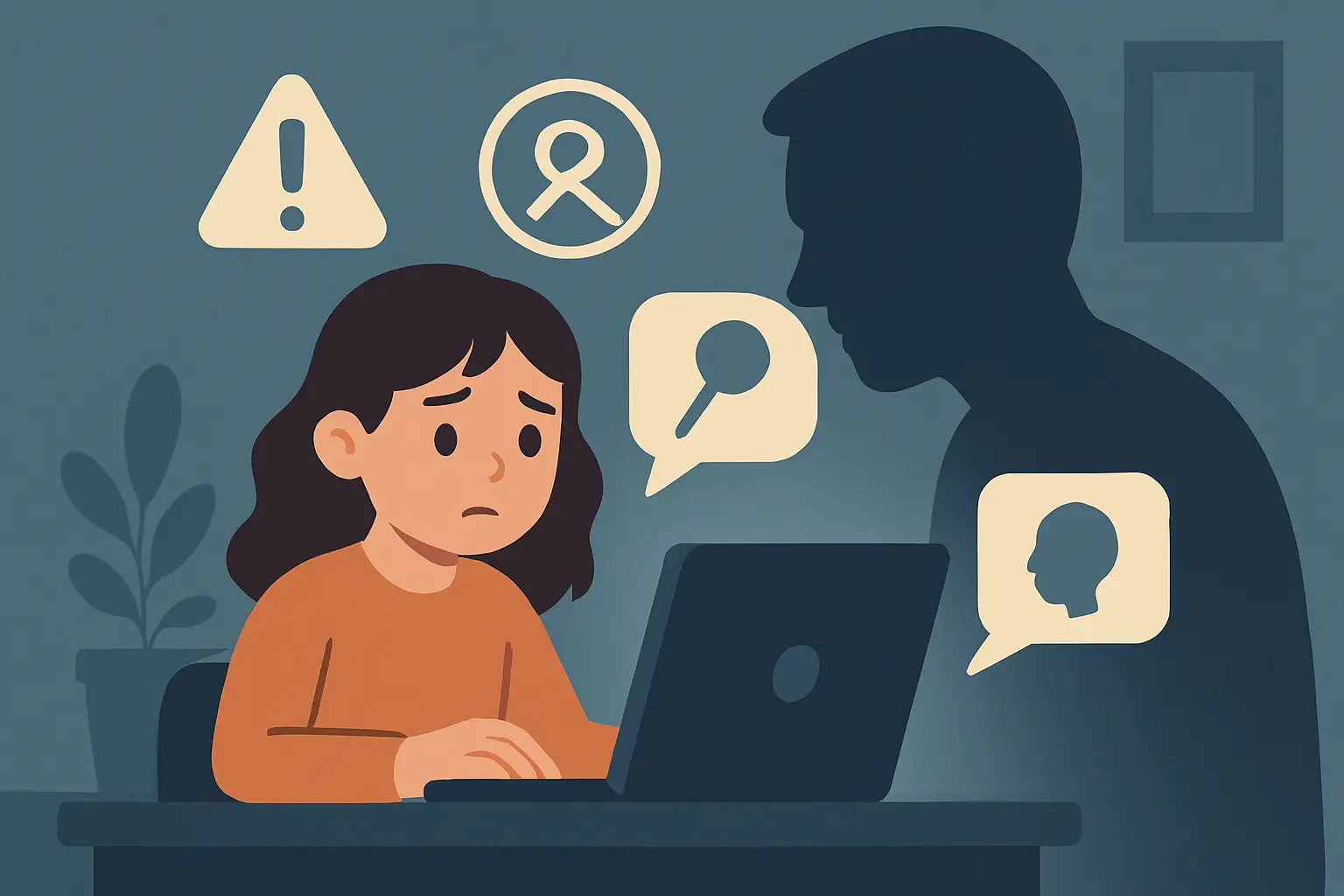
Online grooming rarely looks like the movies. It often looks like attention, humour, compliments, and a “friend” who seems to really get your child. The danger is not only sexual. Grooming can also lead to blackmail, coercion, money demands, pressure to share images, or being pulled into secretive relationships that leave your child scared and isolated.
This is a practical guide to the signs your child is being groomed online, how grooming typically unfolds, and what to do next without blowing up trust at home.
What online grooming actually looks like
Grooming is a pattern of behaviour where an adult (or sometimes an older teen) builds trust with a child to cross boundaries – gradually and strategically. It can happen on social media, gaming chats, messaging apps, live streams, group chats, and even learning platforms.
A key thing parents miss is that grooming does not begin with overt sexual messages. It begins with connection. The groomer studies what your child wants – belonging, validation, romance, help with homework, a way to feel grown up – then uses it as leverage.
It also depends on the child. A confident, popular teen can be groomed. So can a child who is lonely, anxious, neurodivergent, or going through family stress. Groomers target opportunity, access, and emotional openings, not one “type” of kid.
The signs your child is being groomed online
No single behaviour proves grooming. Teens guard privacy, tweens test boundaries, and lots of kids get weird online messages they ignore. What matters is a cluster of changes, especially secrecy plus a new intensity around one person.
1) A sudden jump in secrecy around devices
You might notice your child snapping their phone face-down, taking it everywhere (even to the loo), or getting edgy if you come near while they are messaging. They may delete message threads, clear chat histories, or use “hidden” folders.
Some kids will insist on using headphones for everything, or they will only use certain apps in private. On its own, that can be normal adolescence. Paired with mood changes, new gifts, or late-night messaging, it is worth leaning in.
2) A relationship you are not allowed to know about
Groomers rely on secrecy. Your child may mention a “friend” who you never meet, who has a vague backstory, or who keeps changing details. Or your child may refuse to say who they are talking to, insisting, “You wouldn’t understand,” or, “You’ll make me stop talking to them.”
Watch for language that sounds coached. Statements like “You’re just being controlling,” or “This is my private life,” can be normal teen pushback, but they are also phrases groomers use to frame you as the enemy.
3) Compliments that feel intense or adult
Groomers often use flattery to hook a child quickly: “You’re so mature,” “You’re different from other people,” “You’re the only one I can talk to.” It creates a sense of specialness and loyalty.
If you hear your child repeating those ideas, or you see them chasing the high of constant validation, take it seriously. The point is not the compliment – it is the emotional dependence it creates.
4) Isolation from friends and family
A groomer wants your child alone, emotionally and literally. Your child may suddenly stop seeing friends, stop joining family routines, or withdraw into their room to message. They might drop clubs or sports they used to enjoy.
Sometimes isolation is subtle: they are physically present but mentally elsewhere, always half-in a conversation you cannot see.
5) Mood swings linked to their phone
If messages seem to dictate their mood – elation, panic, irritability, tears – pay attention. Grooming can involve cycles of attention and withdrawal: love-bombing, then silence, then pressure.
You might also notice anxiety when they cannot access their phone, or they wake in the night to check notifications.
6) Sexualised behaviour or sudden boundary shifts
This can show up as new sexual language, jokes that feel unusually explicit, a new interest in porn, or asking questions that sound like they came from an adult. Some children become more secretive about their bodies or change how they dress in ways that feel driven by someone else’s approval.
Other children go the opposite way: they become ashamed, fearful, or disgusted, and they avoid conversations about relationships entirely.
7) Money, gifts, and “favours” you cannot account for
Groomers sometimes send top-ups, in-game purchases, gift cards, or small parcels. Or they pressure children to send money, buy codes, or “help out” because of an invented crisis.
If your child suddenly has new items, extra cash, or is anxious about money and will not explain why, treat that as a red flag.
8) A new older friend or romantic interest with blurry details
Not every age-gap friendship is harmful, but grooming often involves an older person who claims they are “not like other adults” or who says they are only 15/16 when they are not.
Be wary of any online relationship where you cannot verify the person’s identity, age, and real-world connections. Groomers commonly use fake profiles, stolen photos, or a carefully built persona.
9) Pressure to keep secrets, send photos, or move platforms
A big grooming step is shifting to more private spaces: encrypted chats, disappearing messages, alternative accounts, or apps you have never heard of. Another step is testing boundaries: “Send a pic,” then “Just one without your school uniform,” then “Make it more private.”
If your child mentions “don’t tell anyone” or seems afraid of what will happen if messages are seen, assume pressure is happening – even if they say they are fine.
10) Fear, shame, or talk of being “in trouble”
Children who are being groomed often feel complicit. They may worry you will be angry, that they will lose their phone, or that they have done something “bad”. Groomers exploit that shame to keep control.
Listen for: “You’ll hate me,” “Promise you won’t be mad,” “I can’t tell you.” Those are not proof, but they are a strong cue to respond gently and stay calm.
Why kids do not tell you (even when they are scared)
Most parents imagine their child would come straight to them. But grooming is designed to make disclosure feel impossible. Your child may:
- Enjoy the attention and feel loyal to the person.
- Fear losing their phone or freedoms.
- Worry they will be blamed for flirting, sending a photo, or “leading them on”.
- Be threatened with exposure (including sending images to friends or school).
If you want the truth, your nervous system matters. A calm parent gets more information than an angry one.
What to do if you suspect grooming
You do not need certainty to act. You need a plan.
Start with a conversation that keeps the door open
Pick a low-pressure moment (car rides work well). Keep your voice neutral. Try:
“I’ve noticed you seem stressed after you’ve been messaging. I’m not here to take your phone or judge you. I just want to make sure you’re safe. Can you help me understand who you’re talking to?”
If they shut down, try a smaller ask:
“Can you show me the last few messages so I can understand what’s going on? We can do it together.”
Avoid leading with accusations like “Are you being groomed?” Most kids will deny it, even if they are worried.
Do not delete anything
Your instinct might be to block, delete chats, or wipe apps. Don’t. Messages, usernames, images, and timestamps can be evidence if you need to report it. Take screenshots, note account handles, and save URLs where relevant.
Reduce contact without triggering panic
If your child is emotionally hooked, going cold-turkey can cause distress and secrecy. Depending on the situation, you might agree on immediate safety steps: turning off DMs from strangers, changing privacy settings, removing unknown followers, or moving devices to charge overnight outside bedrooms.
For younger children, you may need to take firmer control of accounts and devices. For teens, aim for collaboration: “We are going to tighten this up together because someone is pushing your boundaries.”
Get the right support quickly
If there is any sexual content, request for images, threats, or exchange of explicit images, treat it as urgent. If your child is in immediate danger or you believe an adult is trying to meet them, contact the police.
If you are not sure what you are looking at, talk to your child’s school safeguarding lead or your GP for support routes. You can also reach out to a trusted parenting resource like Kiwi Families for practical, conversation-ready guidance as you work out next steps.
If images have been shared: keep your child with you
This is where shame spirals happen. Say it plainly:
“Thank you for telling me. You’re not in trouble. The adult is responsible here. We’re going to sort it out together.”
Then focus on protection, not punishment. Many children who are being sextorted are terrified of losing everything. Reassure them you will handle the adults and systems around it.
Prevention that does not rely on perfect parenting
You cannot supervise your way into total safety, especially with teens. What you can do is make grooming harder and disclosure easier.
Keep device rules simple and consistent: phones out of bedrooms overnight is one of the highest-impact changes for many families. Use privacy settings, age-appropriate parental controls, and shared account visibility for younger kids – but explain these as safety measures, not spying.
More importantly, normalise conversations about online behaviour early. Talk about what a respectful message looks like, what pressure feels like, and what to do when someone asks for secrecy. You are building an instinct in your child: “When something feels off, I can tell my adult.”
If you want one line to repeat until it sticks, make it this: “Anyone who asks you to keep secrets from your parents is not safe.”
Keep the focus where it belongs: your child does not need a perfect lecture, they need a steady adult who can sit beside them, look at the facts, and take the next right step.
Related posts:
 The One Phrase That Quietly Destroys Your Child’s Confidence—Avoid, Avoid, Avoid!
 Ex-Bullies Speak Out: What Made Them Stop — And What Parents Should Know
 What Confident Kids Learn Early — That Most Kids Don’t Even Hear About
 Don’t Say This If You Want Your Child to Listen—It Has the Opposite Effect
