

In this article
- What a toddler tantrum actually is (and why it matters)
- Toddler tantrums – how to respond in the moment
- What to say: quick scripts that actually work
- After the tantrum: the part most parents miss
- How to reduce tantrums over time (without tiptoeing around your toddler)
- When it depends: public tantrums, siblings, and co-parenting
- When to get extra support
- A closing thought to keep in your pocket
You’re halfway through the supermarket shop and your toddler’s body suddenly becomes a protest. They’re on the floor. Loud. Possibly damp. Everyone’s looking, and your brain is sprinting through options: bribe? carry them out? abandon the trolley and move to the woods?
Tantrums are a normal part of toddlerhood, but “normal” doesn’t make them easy. If you’re searching toddler tantrums how to respond, what you usually need is something you can do in the moment that doesn’t escalate, plus a plan that makes the next one less likely.
What a toddler tantrum actually is (and why it matters)
A tantrum isn’t your child being “naughty” in the way adults mean it. It’s a loss of control when their feelings and their skills don’t match up. Toddlers have big wants, fast-changing bodies (hungry, tired, overstimulated), and a very small toolkit for coping when something doesn’t go their way.
Some toddlers melt down because they can’t have the biscuit. Others melt down because the biscuit broke. The point is not the trigger – it’s the overwhelm.
If you treat a tantrum as defiance, you’ll instinctively go harder: more threats, more volume, more pressure. If you treat it as dysregulation, you’ll aim for safety, limits, and connection – and you’ll save your energy for the moments where boundaries really matter.
Toddler tantrums – how to respond in the moment
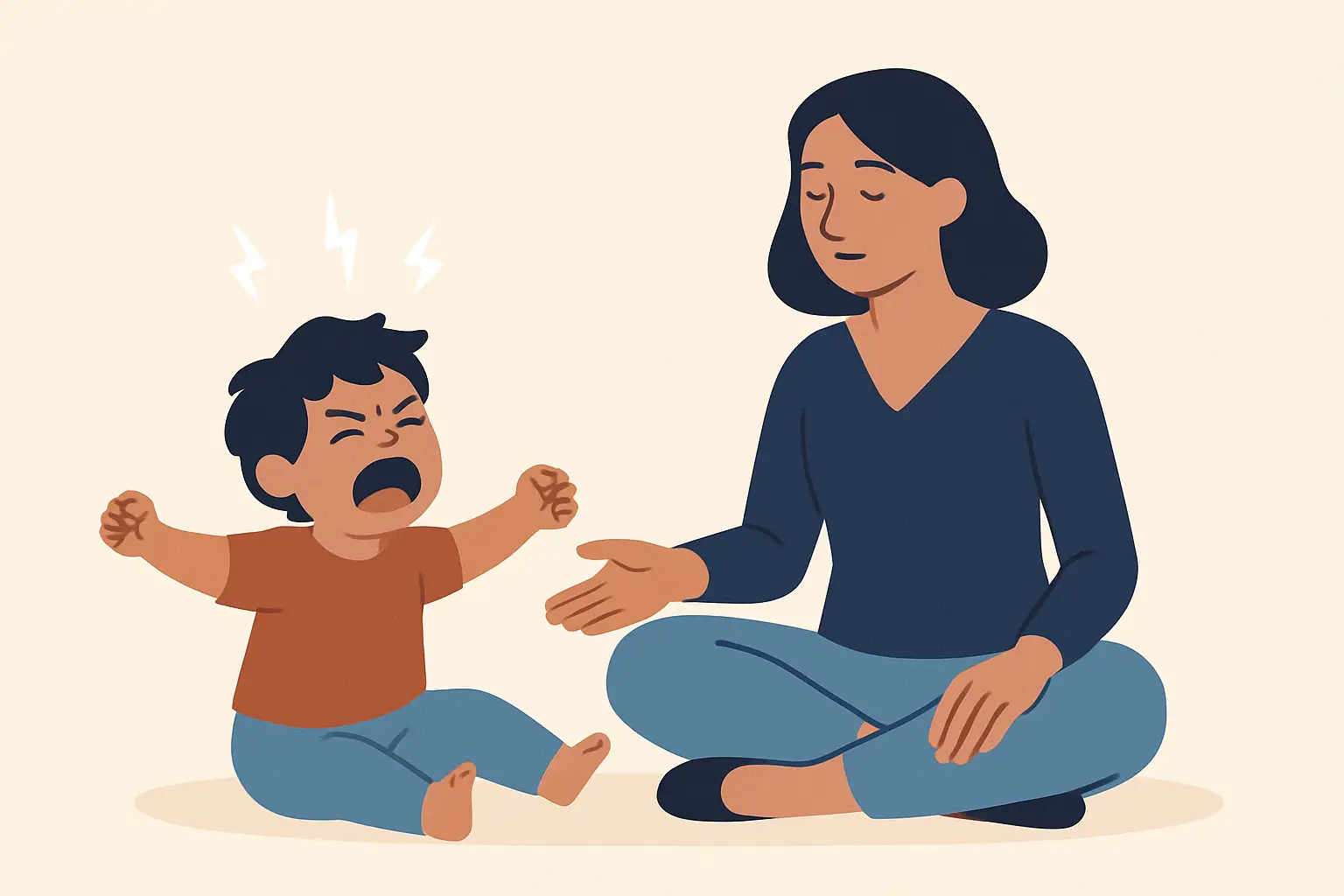
The goal during a tantrum isn’t a “teachable moment”. It’s to help your child come back to calm without you losing your own.
Step 1: Check safety, then get low and steady
If your toddler is kicking, hitting, throwing, or near a road/car park, your first job is safety. Move objects, block hits with your forearm, or pick them up and move them to a safer spot. You’re not rewarding anything – you’re containing it.
Then, bring your voice down rather than up. Toddlers borrow your nervous system. Your calm is contagious, even when they look like they’re ignoring it.
Try: “I won’t let you hurt me. I’m here.”
Step 2: Name the feeling, not the behaviour
When you label what’s happening, you help your toddler’s brain organise the experience. Keep it short. You’re not giving a lecture – you’re offering a handle.
Try: “You’re really cross.” or “That’s so frustrating.”
Avoid: “Stop crying.” “Use your words.” “You’re fine.” (They’re not fine, and they know it.)
Step 3: Hold the boundary once, clearly
A boundary should be simple enough to repeat verbatim when you’re tired.
Try: “We’re not buying sweets today.”
If they scream louder, that doesn’t mean the boundary was wrong. It means they didn’t like it.
The trade-off here is real: if you change the boundary to make the noise stop, you might buy a quiet five minutes today, but you’re teaching them that louder and longer works. If you keep the boundary, you might have a public scene now, but you’re building the skill of coping with disappointment.
Step 4: Offer limited choices only if they can take them
Choices can be brilliant – but not when your toddler is already in full meltdown. In that moment, more words can feel like more demands.
If they’re teetering on the edge rather than fully gone, a choice can help.
Try: “Do you want to hold my hand or sit in the trolley seat?”
If they’re already on the floor, keep it to presence and safety: “I’m staying close.”
Step 5: Reduce your language, not your empathy
Many parents accidentally feed a tantrum with well-meaning explaining. Your toddler can’t process long sentences while flooded with emotion.
A good script is calm, repetitive, and boring.
Try: “You wanted the biscuit. It’s not available. I’m here.”
Step 6: Don’t argue with the tantrum
If your toddler shouts “I hate you!” or “You’re mean!”, your job is not to defend your character. It’s to stay anchored.
Try: “You’re so angry. I won’t let you hit. We’ll talk when your body is calm.”
This is where you’re modelling emotional maturity: feelings are allowed, unsafe behaviour isn’t.
What to say: quick scripts that actually work
When you’re running on empty, you need phrases you can remember.
When they can’t have something
“I know you want it. It’s a no.”
When they’re hitting/kicking
“I won’t let you hit. Hands stay down.”
When they’re throwing things
“Throwing isn’t for indoors. I’m moving this away.”
When it’s time to leave
“It’s time to go. You can walk or I will carry you.”
When you’re getting overwhelmed
“I need a deep breath. I’m safe. You’re safe.” (Yes, you can say it out loud.)
These scripts aren’t magic words. They work because they’re consistent, non-shaming, and they keep the adult in charge of the boundary.
After the tantrum: the part most parents miss
The tantrum ends when your toddler’s body settles, not when you “win”. Once they’re calm-ish, you have a chance to reconnect and gently teach.
Keep it brief. Toddlers don’t need a post-match analysis.
Try:
“You had a big feeling. You wanted the sweet.”
Then:
“Next time, we can stamp our feet or ask for a cuddle – not hit.”
If they’re old enough (closer to 3), you can practise a replacement skill later when everyone is regulated: stomping, squeezing hands, blowing “birthday candle” breaths.
If you need to apologise because you shouted, do it. Not a dramatic guilt dump – just a clean repair.
Try: “I shouted. That was too loud. I’m sorry. Next time I’ll try a calmer voice.”
That teaches accountability without giving away authority.
How to reduce tantrums over time (without tiptoeing around your toddler)
You can’t eliminate tantrums completely – and you don’t want to. A toddler who never melts down is either unusually easy-going or has learned it’s not safe to show big feelings. What you’re aiming for is fewer, shorter tantrums and quicker recovery.
Protect the basics: sleep, food, and transitions
Most blow-ups are built on predictable foundations: hungry, tired, overstimulated, rushed.
If tantrums peak at 5pm, it might not be “bad behaviour”. It might be end-of-day collapse. A snack before pick-up, a simpler dinner routine, or a quieter hour can make a noticeable difference.
Transitions are another hotspot. Toddlers hate being yanked from one world to another.
Try: “Two more slides, then we’re going.”
If your toddler can’t handle “two”, try a physical marker: “After this song ends.”
Make “no” less personal and more predictable
Toddlers cope better when boundaries feel steady rather than mood-based.
If the rule is “We don’t buy toys at the supermarket”, keep it true even on days you could cave. If you want to buy a treat sometimes, build it in as a predictable routine: “Friday treat after nursery.” The predictability reduces the fight.
Catch them being regulated
It can feel cheesy, but noticing the moment they cope is powerful.
Try: “You were upset and you took a breath. That was hard.”
You’re reinforcing the skill, not praising them for being convenient.
Prepare for known triggers
If hair washing always ends in tears, do a tiny pre-brief when you’re both calm.
Try: “In the bath, we wash hair. It might feel yucky. You can hold the flannel or tip your head back. I’ll be quick.”
Preparation doesn’t guarantee peace, but it reduces the shock that fuels a spiral.
When it depends: public tantrums, siblings, and co-parenting
Real life is messy. Tantrums don’t happen in a tidy lab.
If you’re in public, your priority is still safety and containment. You don’t owe strangers a performance, but you also don’t have to martyr yourself on aisle seven. If you can, move to the car, a quiet corner, or outside for a reset. If you can’t, do your steady script and keep going.
If there’s a sibling involved, you might need to split roles: one adult helps the toddler, the other protects the sibling and carries on. If you’re solo, narrate it simply: “I’m helping your brother. You’re safe next to me.” It’s not perfect, but it’s real.
If you co-parent, consistency helps, but perfection isn’t required. The better goal is shared principles: no hitting, calm voice, clear boundary, repair after. If one parent is more permissive, focus on what you can control – your responses – and keep your household rules predictable.
When to get extra support
Some tantrums are typical; some are a sign your child is struggling more than expected.
Consider extra support if tantrums are very frequent and intense for weeks, your toddler is harming themselves or others often, you’re seeing a big change in sleep or eating, or you feel scared of your own reactions. It can also be worth checking hearing, speech and language development, and sensory sensitivities – toddlers who can’t communicate clearly often melt down more.
If you want more stage-based guidance like this, Kiwi Families has a wide library of practical parenting resources you can dip into when you’re in the thick of it.
A closing thought to keep in your pocket
A toddler tantrum can feel like a verdict on your parenting, especially when it’s loud and public. It isn’t. It’s your child borrowing your calm until they can build their own – and every time you respond with steady boundaries and a regulated presence, you’re quietly teaching a life skill that will outlast this phase.