
That 2am moment when your baby will only settle on your chest can make every sleep plan you had feel a bit theoretical. For many parents, the question of co-sleeping vs cot-sleeping safety is not abstract at all – it shows up when everyone is exhausted, the house is dark, and you just need to get through the night.
This is where clear advice matters. Not guilt, not online arguments, and not a fantasy version of family life where every baby happily drifts off alone in a cot. The safest sleep setup for a baby is generally their own clear, flat sleep space, such as a cot or Moses basket, in the same room as their parents. But real life is messier than that, and some families do end up bed-sharing, whether planned or not. The key is understanding the risk difference and making safer choices from the start.
Co-sleeping vs cot-sleeping safety: what is actually safer?
If we are talking strictly about risk, cot sleeping is the safer option for babies, especially in the early months. A cot provides a separate sleep surface designed for infant safety. That means a firm mattress, no pillows, no loose bedding, and no adult body nearby that could accidentally obstruct breathing or cause overheating.
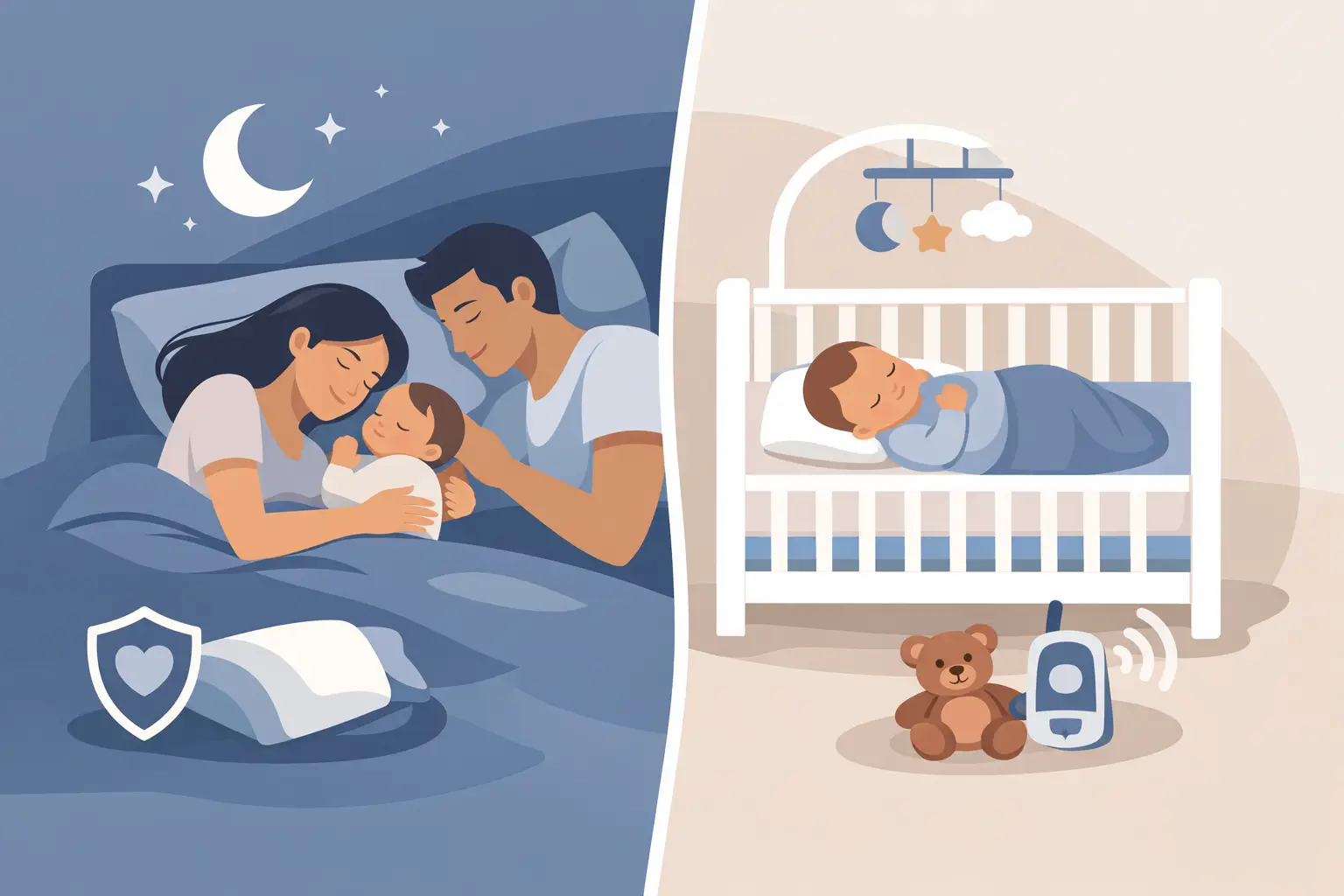
Co-sleeping is often used as a catch-all term, which can muddy the conversation. Sometimes people mean room-sharing, where baby sleeps in a cot beside the bed. Sometimes they mean bed-sharing, where baby sleeps in the same adult bed as a parent. Those are not the same thing. Room-sharing is widely recommended because it keeps your baby close while preserving a separate sleep space. Bed-sharing carries more risk, and that risk can rise sharply depending on the circumstances.
The honest version is this: not all bed-sharing situations carry the same level of danger, but none are as predictably safe as a baby sleeping alone in a clear cot beside the bed.
Why cot sleeping lowers risk
A cot removes many of the hazards that come with adult sleep spaces. Adult mattresses are often softer than infant sleep surfaces. Duvets, pillows and throws can cover a baby’s face. Gaps between the mattress and headboard or wall can trap a baby. Adults are also heavier, move in sleep, and may not wake easily if a baby shifts into a dangerous position.
A properly set up cot is simpler. Baby is placed on their back, on a firm flat mattress, with bedding kept minimal and away from the face. There is less guesswork, and that matters when you are tired.
For younger babies, especially newborns and babies under six months, this separate sleep space is particularly important. Their airways are small, their head control is limited, and they are less able to move away from danger if something obstructs breathing.
Room-sharing gives you the best of both worlds
Parents often hear “don’t co-sleep” and assume that means baby must be in another room. It does not. Having your baby in a cot in your room makes night feeds easier, helps you keep an eye on them, and avoids the higher risks linked with bed-sharing.
For many families, this ends up being the most realistic compromise. You are close enough to respond quickly, but your baby still has a sleep space built for them.
When co-sleeping becomes more dangerous
This is the part parents need spelled out plainly. Bed-sharing becomes significantly riskier if any of the following apply: your baby was premature or had a low birth weight, your baby is under three months old, either parent smokes, anyone in the bed has drunk alcohol, taken drugs, or used medication that causes drowsiness, or the parent is extremely exhausted.
Surface matters too. Sleeping with a baby on a sofa or armchair is especially dangerous. If there is one message to remember for those desperate nights, it is this: do not fall asleep with your baby on a sofa or in an armchair. That is one of the highest-risk situations because babies can become trapped against cushions or the adult’s body very quickly.
Bed-sharing is also unsafe if there are pillows, heavy bedding, pets, older siblings, or spaces where a baby could roll and become trapped.
Why some parents choose co-sleeping anyway
Parents are not choosing bed-sharing because they have not heard the rules. Often they are trying to survive fragmented sleep, recover from birth, manage feeding challenges, or settle a baby who wakes every hour. For breastfeeding mothers in particular, bed-sharing can feel like the only workable option.
That does not mean the risks disappear. It does mean advice needs to be realistic. Telling parents “just don’t do it” without acknowledging what happens at 3am is not very useful. A better approach is to lead with the safest option – cot in the parents’ room – while also explaining how to reduce risk if bed-sharing might happen.
This is especially important because unplanned bed-sharing can be riskier than planned bed-sharing. If a parent feeds a baby in bed and falls asleep accidentally in a cluttered, unsafe sleep space, that can be more hazardous than preparing the bed carefully beforehand.
If you might fall asleep with your baby, do this first
If there is any chance you may bed-share, set things up with safety in mind before you are half asleep. Remove pillows and duvets from the baby’s area. Keep baby away from the edge of the bed and away from gaps. Make sure no one in the bed smokes, has been drinking, or is unusually drowsy. Never place the baby between two adults, next to another child, or on a sofa.
Dress baby lightly to avoid overheating, and always place them on their back.
This is not the same as saying bed-sharing is equally safe. It is not. This is harm reduction for tired parents, and sometimes harm reduction is the most honest form of support.
How to decide what works for your family
The right question is not just, “What is ideal?” It is also, “What am I likely to do when I am exhausted?” If your plan is cot sleeping but you keep bringing baby into bed during feeds and nodding off without meaning to, it is worth pausing and resetting your routine.
You might move the cot or bedside crib closer, keep feeds calm and low-lit, and return baby to their own sleep space after each feed. If getting up repeatedly is the issue, think about what would make that easier rather than gritting your teeth and hoping for more willpower.
Some parents find that a side-sleeper cot attached securely to the bed gives them closeness without full bed-sharing. Others do better with a standard cot in the same room because it creates a clearer boundary. There is no prize for choosing the setup that looks best online. The goal is a sleep arrangement you can maintain safely, night after night.
What to say if you and your partner disagree
Sleep decisions can carry a surprising amount of tension. One parent may feel strongly that bed-sharing is natural and calming. The other may feel anxious every time the baby comes into bed.
Try this: “Let’s work from safety first, then convenience. If we are going to keep baby in our bed sometimes, we need rules we both follow every time.” That shifts the conversation away from blame and towards a plan.
Common myths about co-sleeping vs cot-sleeping safety
One common myth is that co-sleeping is either completely safe or completely reckless. Neither is true. Risk exists on a spectrum, and some situations are far more dangerous than others.
Another myth is that if a baby prefers contact sleep, a cot is impossible. Many babies resist it at first. That does not mean they can never sleep safely in a cot. Sometimes it takes gradual practice, a consistent bedtime routine, and realistic expectations about how broken early sleep can be.
There is also a stubborn idea that “I would never sleep deeply enough to roll onto my baby.” Parents often believe this, and sometimes they are right. But exhaustion changes sleep, and safety advice cannot rely on confidence alone.
The bottom line for tired parents
If you want the lowest-risk option, choose a cot or other separate baby sleep space in your room. Keep it clear, flat and firm. Put baby on their back for every sleep.
If bed-sharing is happening or feels likely, be brutally honest about the risk factors. No smoking, no alcohol, no drugs, no sofas, no armchairs, no heavy bedding near baby, and extra caution for very young, premature, or low birth weight babies.
At Kiwi Families, we know most parents are not looking for a lecture. They want an answer they can use tonight. Start with the separate cot beside your bed if you can. If your reality is messier than that, make the next sleep the safest one possible. Parenting does not need perfection. It does need clear-headed decisions when you are running on very little sleep.