

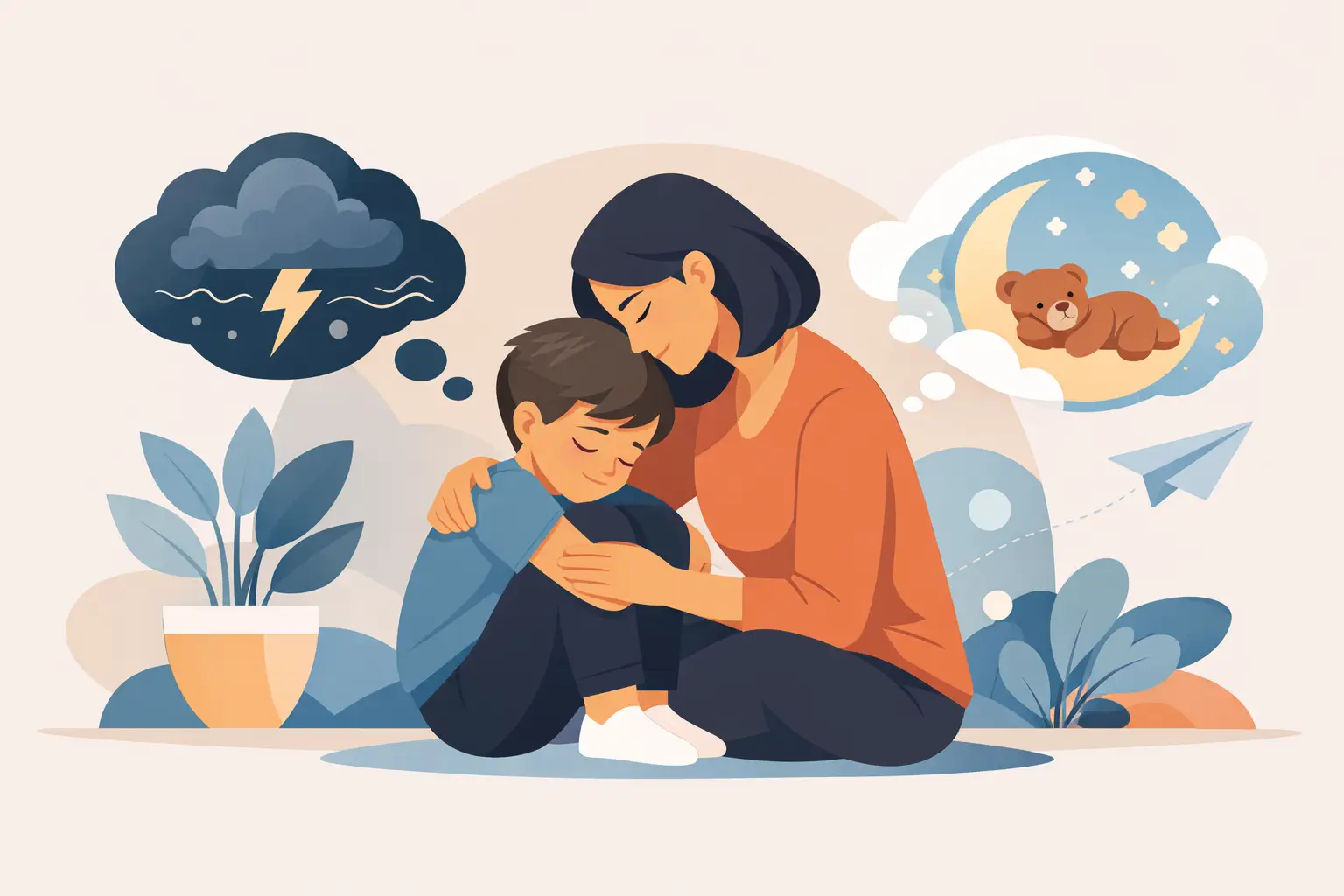
A child melting down in the supermarket aisle, sobbing at school drop-off, or spiralling before bed does not give you ten calm minutes to think. When you need to know how to calm a child quickly, the goal is not to win, lecture, or force instant obedience. It is to lower the emotional temperature fast enough that your child can feel safe again – and you can think clearly too.
That matters because a dysregulated child is not refusing to be reasonable. In that moment, they usually cannot access reasoning well. The quickest route through is often less talking, more co-regulation, and one simple next step.
How to calm a child quickly in the moment
Start by checking your own volume, pace, and body language. If your voice rises, your child’s nervous system often takes that as proof that the situation is getting bigger, not smaller. Speak more quietly than feels natural. Slow your movements. Get down to their level if it is safe to do so.
Then make the environment easier. Move away from bright lights, noise, siblings, an audience, or whatever is adding fuel. A child who is overwhelmed in a busy place may settle much faster in the car, outside on the footpath, or in a quiet bedroom than they ever will under fluorescent lights with six people watching.
Next, say less. Parents often talk too much when they are stressed, and children tune out when they are overloaded. Short, clear phrases work better: “You’re safe.” “I’m here.” “We’re going to the quiet spot.” “Breathe with me.” That is enough.
Touch can help, but it depends on the child. Some children calm quickly with firm, steady physical reassurance like a cuddle, hand on the back, or sitting close. Others cannot tolerate touch when upset and will push you away. If that happens, give them space without disappearing. You are aiming for presence without pressure.
One of the fastest ways to help is to focus on the body before the behaviour. Offer water. Encourage slow breaths without making it a performance. Try grounding through the senses: cold water on hands, bare feet on grass, holding a soft toy, counting five red things in the room. These work because they give the brain a concrete job when emotions are too big.
What to say when your child is overwhelmed
Parents often want a script because words matter in the hot moment. The trick is to sound calm without sounding fake. Validation helps, but only if it is simple and believable.
You might say, “You’re really upset. I’m staying with you.” Or, “I can see this feels big right now.” If your child is angry, “You’re angry, but I won’t let you hit” is clearer than a long explanation about feelings and consequences. It names the emotion and keeps the boundary.
Avoid questions that demand logic too early, like “Why are you doing this?” or “What’s wrong with you?” Even “Can you calm down?” can land badly. A child in full fight-or-flight usually cannot tell you why yet. They need help getting back to a place where words are possible.
If your child is old enough, offer two simple choices. “Do you want a cuddle or space?” “Do you want to sit in the car or walk with me?” “Do you want your drink bottle or your teddy?” Choice can restore a sense of control without handing over the whole situation.
Age matters more than most parents think
The best answer to how to calm a child quickly depends a lot on age, temperament, and what triggered the upset.
Babies and toddlers
With babies and toddlers, fast calming is mostly sensory. Hold them close, reduce stimulation, sway, pat, feed if appropriate, and use a calm repetitive phrase. Toddlers often need much less language than adults expect. A tired two-year-old in full flood may calm faster with a cuddle and a change of scene than with any “use your words” coaching.
Tantrums at this age are often about hunger, tiredness, frustration, or transitions. If you can spot the pattern early, you can sometimes prevent the full explosion. But once it is happening, keep it simple and stay nearby.
Preschool and primary-aged children
Children in this stage can often follow a short calming routine if you practise it when they are not upset. That might be three balloon breaths, a sip of water, and sitting in a cosy corner with you. Familiar routines work better than new strategies introduced mid-meltdown.
This is also the age where embarrassment and pressure can make things worse. A child crying at football or after school may need privacy before they need a lesson about resilience.
Older children and tweens
Older children can look more in control than they are. They may slam doors, shout, argue, or freeze rather than cry. Trying to “win” with logic usually drags things out. Keep your language respectful and brief. “We’re not solving this while you’re this upset. Take ten minutes. I’m here when you’re ready.”
Some children this age calm faster through movement than talking. A walk, bouncing a ball, a shower, or music through headphones can help reset them. The key is to avoid turning calm-down time into punishment.
When quick calming does not work straight away
Sometimes the fastest route is not actually fast. That is frustrating, especially if you have other children to collect, dinner to sort, or neighbours listening through the wall. But if a child feels pushed to stop before they are able to, the distress can spike.
If your child is escalating, strip the response back even more. Fewer words. Fewer people. Fewer demands. Stay close enough to keep everyone safe. Repeat one line if needed: “I’m here. You’re safe. I’ll talk when you’re ready.”
There is also a difference between a tantrum and a meltdown, though the two can overlap. Tantrums are often linked to wanting something, avoiding something, or testing a boundary. Meltdowns tend to be more about overwhelm, sensory overload, anxiety, or emotional flooding. Both need calm adults, but meltdowns usually need more protection from stimulation and less focus on consequences in the moment.
What not to do if you want fast results
Threats can stop behaviour briefly, but they rarely create genuine calm. Shaming, public telling-off, or saying “big boys don’t cry” may quieten a child while making them feel less safe with you.
Trying to reason too early is another common trap. So is demanding eye contact, insisting on an apology in the middle of the storm, or adding too many instructions at once. “Stop crying, sit down, say sorry, and tell me what happened” is far too much for a child who is already overloaded.
Bribery has trade-offs too. Sometimes a snack or a change of activity genuinely helps because the child is hungry or overstimulated. But offering a treat every time your child explodes can quickly teach the wrong lesson. The difference is whether you are meeting a need or negotiating with chaos.
After the storm: the bit that makes next time easier
Once your child is calm, that is when you can get curious. Keep it low-key. “What was the hardest part?” “Did it feel too noisy?” “Were you tired before we left?” “What could help next time?” This is where children learn to recognise their own signs and practise different responses.
It also helps to notice patterns without blaming yourself. Some children unravel after school because they have held it together all day. Some lose it in shops, around transitions, or when screens end. If you know your child’s pressure points, you can plan ahead with snacks, warnings, downtime, and realistic expectations.
If meltdowns are frequent, intense, or getting harder to manage, step back and look for bigger factors such as sleep problems, anxiety, neurodivergence, sensory sensitivities, friendship stress, or family strain. Quick calming strategies are useful, but they are not a substitute for understanding what keeps tipping your child over the edge.
And if your child is regularly becoming unsafe, hurting themselves, hurting others, or seems constantly on high alert, it is worth getting professional support. Parents do not need to wait until things are unbearable.
The most effective parents are not the ones who stop every meltdown instantly. They are the ones who can stay steady, protect safety, and help their child come back from the edge without turning it into a power struggle. That steadiness is what children remember, and over time it is what helps them learn to calm themselves too.