

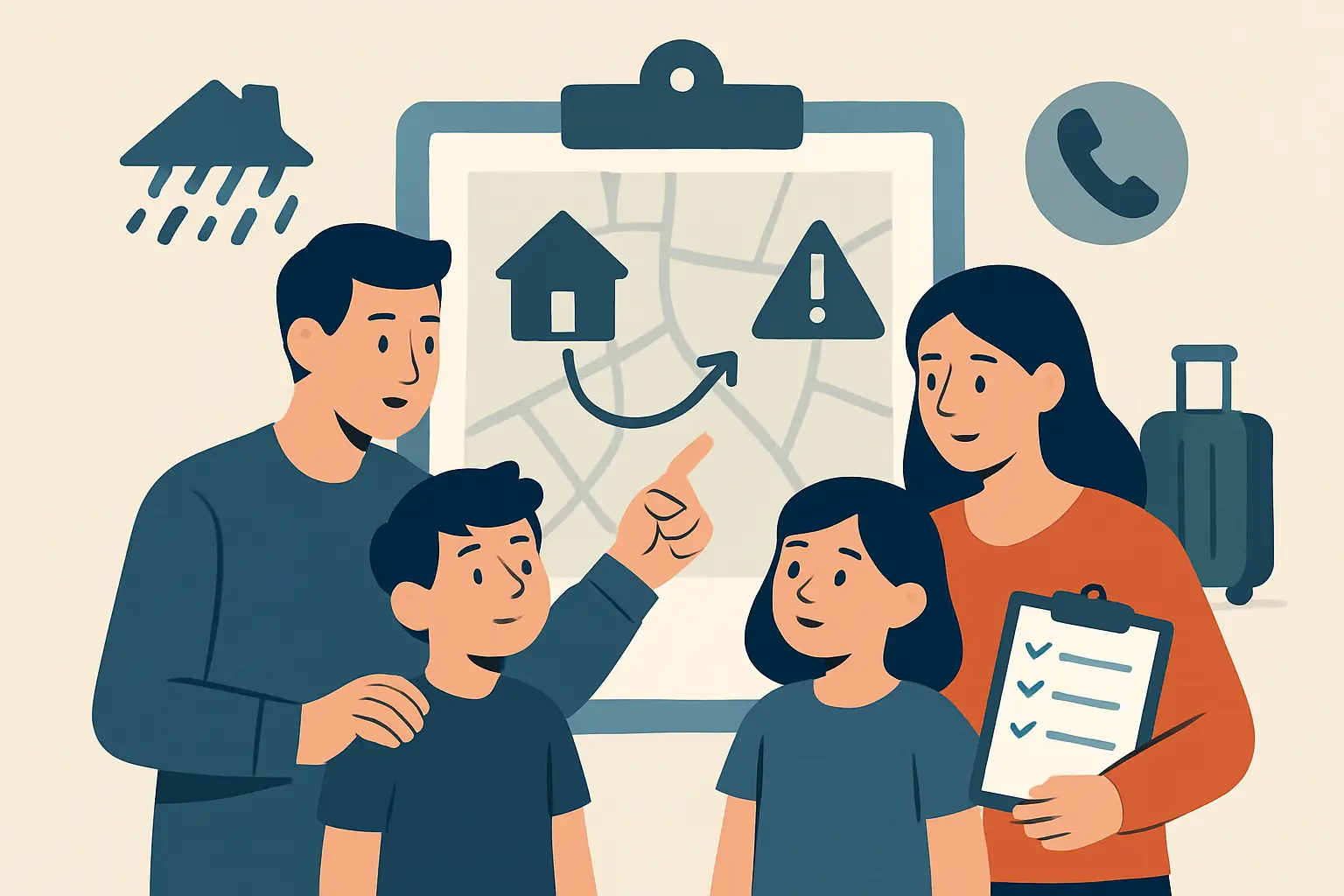
You do not need a binder, a laminator, or a weekend free. You need a plan that still makes sense when your phone is on 3%, one child is crying, and you are trying to remember whether the cat carrier is in the loft or the boot.
Most families already have the raw material for an emergency plan – they just have it scattered across brains, group chats, and half-finished school forms. The goal here is to pull it into one simple system you can use under stress.
What “family emergency plan” actually means
A family emergency plan is not a prediction of the worst case. It is a set of decisions you make while calm so you do not have to make them while panicked. It answers four practical questions:
Where do we go? Who do we contact? What do we take? How do we communicate if we get separated?
It is also personal. A plan for a family with a baby and a dog looks different from a plan for a family with a teen who takes the bus home alone. It depends on where you live, how you travel, and what risks are realistic in your area (storms, flooding, house fires, power cuts, local incidents).
How to create a family emergency plan without overthinking it
Start with the most likely disruptions, not the most dramatic. For many UK families that is a house fire, a local evacuation, a prolonged power cut, or being unable to get home because of transport disruption.
Write your plan as a one-page “if-then” set of defaults. If we cannot stay in the house, then we go to X. If we cannot reach each other, then we message Y and meet at Z. Defaults reduce arguing and decision fatigue.
Step 1: Pick two meeting places (one near, one far)
Choose an “outside now” point and an “area” point.
Your outside-now point is for a sudden evacuation, like a fire alarm at night. It should be somewhere you can reach in seconds and find in the dark: the big tree across the road, the neighbour’s front gate, the corner of the cul-de-sac. Avoid standing right outside your home where smoke, glass, or emergency services may be.
Your area point is for when you cannot return home or you are separated locally. This might be a friend’s house, a community centre, your child’s school gate, or a specific shop car park. Pick somewhere that is usually accessible and not likely to be closed at night.
Trade-off to be aware of: a school can be a great anchor for children, but during major incidents it may be locked down or used as a relief site. That is why two meeting places helps.
Step 2: Decide who is the “out-of-area” contact
In an emergency, local networks can get jammed. Sometimes a text message to someone outside your area gets through when calls do not.
Pick one reliable adult who lives elsewhere and is likely to answer – a sibling, a close friend, a grandparent. Everyone in the household should know this person’s name and number. The plan is simple: if you cannot reach each other, you each contact that person and leave a short update.
Keep the script basic:
“I’m safe. I’m at [location]. I’m with [who]. Next step is [what you’re doing].”
If you co-parent across households, agree whether you share the same out-of-area contact or each home has its own. Either works. What matters is that children know exactly which number to use depending on where they are.
Step 3: Make a contact list that works when you cannot unlock your phone
Phones are great until they are not: dead battery, cracked screen, no signal, or you are helping a child and cannot scroll.
Create a short list of essential numbers (not every cousin): parents/carers, out-of-area contact, a nearby trusted neighbour, school/nursery, GP, and any key medical contacts.
Store it in three places:
- On paper in your go-bag or by the door
- In each adult’s wallet/purse
- In each older child’s bag (or written inside a phone case)
If your child has a mobile, teach them how to place an emergency call and how to contact your out-of-area person. For younger children, practise saying their full name, address, and one phone number. Not perfectly, just well enough.
Step 4: Assign roles that match real life (not optimism)
The fastest way for a plan to fail is to assign tasks based on who “should” do them rather than who actually will.
Give each adult one clear role. For example: one adult gets children out and to the outside-now meeting point, the other grabs the go-bag and checks pets if safe to do so. If you are a solo parent, your role is simply “get everyone out” – and your plan needs to reflect that by keeping bags minimal and exits clear.
For children, give age-appropriate jobs that reduce chaos:
- Toddlers: hold the pushchair strap or hold your hand
- Primary-age: put on shoes by the door, carry their own coat
- Tweens/teens: grab the go-bag, lead younger siblings to the meeting point, text the out-of-area contact
Be honest about mornings. If your household is always rushing, your plan should not rely on finding items in the back of cupboards.
Step 5: Cover three scenarios: home, away, and separated
Most people plan for “at home”. Families also need a plan for “not at home” and “not together”.
At home: know exits, meeting point, and who grabs what.
Away from home: choose a default place to regroup if something happens in a public location. “If we get separated in a shopping centre, we meet at the customer service desk.” For parks, it might be the main entrance.
Separated: this is where older children need clarity. If your teen is out with friends and there is a local incident, what is the expectation? Do they come home, go to a friend’s, or stay put and check in? The right answer depends on transport, time of day, and safety. Set a rule of thumb plus a check-in requirement.
A simple script for teens:
“If something kicks off and you feel unsafe, get inside a public place with staff, message me and [out-of-area contact], and do not go live on social media about where you are.”
That last bit matters. Location sharing can help families find each other, but broadcasting live location publicly can create risk.
What to pack: the go-bag that does not turn into a hobby
A go-bag is not a camping kit. Think 24 hours of “we can function” rather than “we can thrive”. If you live in a flood-risk area or you have medically complex needs, you may go bigger – but start small so you actually keep it updated.
Your bag should support warmth, basic hygiene, communication, and critical documents. Include any daily essentials you would struggle to replace quickly.
A sensible baseline is:
- Copies of key documents (photos on a USB stick or printed copies in a waterproof pouch)
- Basic first aid items and any essential medications
- A power bank and charging cables
- A torch, spare batteries, and a small radio if you have one
- Water and easy snacks (rotate them)
- Warm layers and a foil blanket
- Cash and a spare set of keys
If you have a baby, add enough nappies, wipes, formula supplies if used, and one comfort item. If you have pets, include a lead, collapsible bowl, and a small supply of food.
Where to keep it depends on your home. By the front door is great until you realise you actually leave through the side gate. Put it where you will grab it.
Medical and accessibility needs: plan for the non-negotiables
If someone in the household has asthma, allergies, diabetes, epilepsy, mobility needs, or sensory needs, your plan should be built around that reality.
Write down medications, doses, and timings. Include NHS numbers if you have them to hand, and any care plans. If a child has an EpiPen, decide where spares live and who carries them. If your child uses noise-cancelling headphones to regulate, add them to the go-bag – they can be as important as a torch.
It also helps to decide in advance who is responsible for grabbing medication. In stress, “someone will grab it” often becomes “nobody grabbed it”.
Communication rules that reduce panic
Agree on two behaviours that keep things moving:
First, if signal is poor, text first. Texts often get through when calls fail.
Second, keep messages short and structured. Under stress people send five frantic updates that do not include location. The earlier script helps: safe, location, who you are with, next step.
If your children are old enough for group chats, consider a family emergency chat that is kept quiet most of the time. The point is not more notifications. It is having a place where everyone knows to look.
Practise it once, then make it a habit
You do not need drills that terrify children. You need one calm walk-through so the plan is not theoretical.
Do a ten-minute run-through on a normal day. Show children the exits and the outside meeting point. Let them practise getting shoes on quickly. Let your teen practise messaging the out-of-area contact.
Then set a reminder every six months to update the plan: new school, new phone numbers, changed medications, seasonal clothing. Tie it to something you already do, like the start of term or the clocks changing.
If you want a place to keep safety checklists alongside other stage-based parenting guidance, you can tuck this into your family admin system with resources from Kiwi Families – the goal is one trusted spot you actually return to.
Common sticking points (and how to handle them)
If your partner is sceptical, frame it as reducing mental load, not indulging anxiety. “I don’t want to figure this out at 2 am” lands better than “what if the house burns down?”
If you co-parent across homes, keep the plan child-centred and consistent where possible: the same out-of-area contact, the same message format, and clear rules about who collects children if schools close. You do not need identical kits in both homes, but you do need shared expectations.
If you have a teen who rolls their eyes, make them the expert. Give them ownership of one part: checking power banks, updating contact numbers, or choosing the public meeting point. They are more likely to follow a plan they helped build.
A family emergency plan is not about controlling every outcome. It is about giving your future self fewer decisions to make on your hardest day – which is a surprisingly kind gift to leave by the door.