

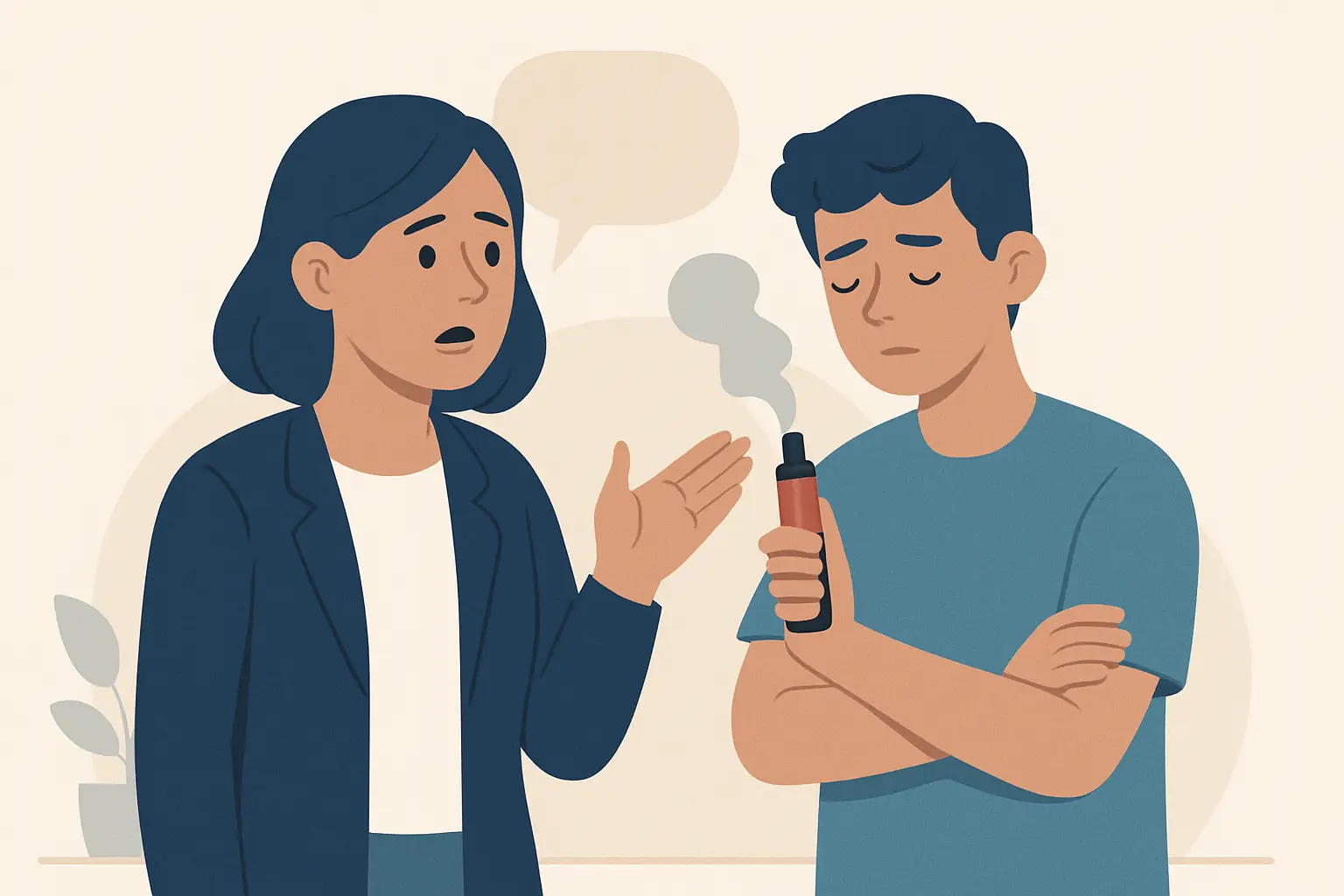
You find a sweet, fruity smell on your teen’s hoodie. Or a tiny “USB stick” looking thing in a pocket. Or you hear the words “just a hit” and your stomach drops.
This is one of those parenting moments where the goal isn’t to win an argument. It’s to keep your relationship intact while you steer them away from something that can hook them fast.
Why vaping talks go wrong (and how to avoid that)
Most parents don’t start with a script – they start with fear. That fear comes out as interrogation, sarcasm, or a long speech. Teens hear judgement and control, and they do what teens do best: shut down, minimise, or go underground.
The better approach is annoyingly simple: get curious first, then get clear. Curiosity keeps the conversation going. Clarity keeps your boundaries intact.
It also helps to remember the real reasons vaping sticks. For some teens it’s about nicotine. For others it’s social belonging, stress relief, boredom, appetite control, looking older, or simply not wanting to be the only one who says no.
Before you talk: pick the right moment and your non-negotiables
If you’re shaking with anger, wait. Not forever – just long enough to be steady. The first conversation sets the tone for every conversation after it.
Choose a low-pressure moment: a drive, doing dishes together, walking the dog. Side-by-side chats feel less intense than face-to-face.
Before you start, decide your “non-negotiables” in plain language. For example: you don’t want nicotine in their body, you won’t supply devices or money for them, and you will act if there’s vaping at school or around younger siblings. If you don’t know what consequence makes sense yet, don’t bluff. It’s fine to say you’ll come back to that.
How to start the conversation without triggering shutdown
Start with what you’ve noticed, not what you suspect. Keep it short.
Here are a few openings that tend to land better than “Are you vaping?”
“Hey, I noticed a really sweet smell on your clothes lately. I might be wrong, but it made me wonder about vaping. Can we talk about it?”
“I found a vape in your bag. I’m not going to yell, but we do need to talk. Help me understand what’s been going on.”
“Loads of kids are vaping right now. What’s it like at your school? Who’s doing it – and how easy is it to get?”
That last one is a quiet power move: you’re asking about the environment first. Teens will often tell you the truth about ‘everyone else’ before they’ll talk about themselves.
The middle bit: what to say when they deny, minimise, or get defensive
If they deny it
Stay calm and widen the door.
“OK. I’m glad to hear that. If it ever comes up – pressure, curiosity, whatever – I want you to be able to tell me without it becoming a massive drama.”
Then ask one practical question:
“What would make it easier to say no if someone offers?”
You’re planting the idea that this is a skill, not a moral test.
If they say, “It’s just flavouring” or “It’s not that bad”
Agree with the feeling, correct the facts.
“I get why it seems harmless – it’s marketed like it’s nothing. The part I care about is that a lot of vapes contain nicotine, and nicotine changes how the teen brain handles stress and cravings. That’s why people get hooked without meaning to.”
Avoid getting stuck in a debate about statistics. Your job is not to deliver a TED Talk. Your job is to set a safe direction.
If they hit you with, “You can’t stop me”
Don’t take the bait. Say this instead:
“You’re right that I can’t control every choice you make. I can control what happens in our house, what I pay for, and how I support you. My job is to keep you safe, even when you don’t love my decisions.”
That’s boundaries without a power struggle.
Ask the questions that actually tell you what’s going on
Once you’ve opened the door, you want specifics – gently. These questions are less “gotcha” and more “map the risk”:
“How often is it happening – once in a while, weekends, most days?”
“Is it nicotine, or just flavours? Do you know what’s in it?”
“Who are you vaping with? Is it your device or someone else’s?”
“What do you get from it – buzz, calm, fitting in, something to do?”
“Have you ever felt like you needed it, or got cranky without it?”
If they’re already dependent, you’ll often hear it in their language: “I just need it”, “I can’t focus”, “I get stressed”. That’s your cue to shift from punishment to support.
Boundaries that work (and ones that backfire)
Teens do better with boundaries that are clear, enforceable, and connected to safety – not shame.
Boundaries that usually work:
No vaping in the house, car, or around younger kids.
No buying vapes, pods, or “just a new charger” with your money.
If school is involved, you’re part of the plan with the school – not kept in the dark.
If there’s a device, it’s removed while you figure out next steps.
What tends to backfire is humiliation (reading messages aloud, posting about it, telling relatives) or consequences that don’t match the behaviour (grounded for three months with no clear path back). If you go nuclear, they go covert.
Try consequences that are short, specific, and linked to rebuilding trust: extra check-ins, phone-free time at night if vaping is happening in the bedroom, or having them help pay back money spent. You can be firm without turning the house into a courtroom.
If your teen is already vaping: move from “stop” to “support”
Some teens can quit with a strong boundary and a bit of coaching. Others can’t – not because they’re weak, but because nicotine is genuinely addictive, and teen brains are especially vulnerable.
A practical way to say it:
“I want you to stop. If it’s hard, that tells me we need a plan, not more yelling. I’m on your team, and I’m still the parent.”
Then offer two choices, both acceptable to you:
“We can work on quitting at home with support and check-ins, or we can get outside help. Which feels more doable?”
If they’ve been vaping daily, have withdrawal symptoms, are anxious/depressed, or you suspect they’re using substances beyond vaping, bring in professional support. Talk to your GP or a youth health service. This isn’t you failing – it’s you taking addiction seriously.
What to do if it’s a social thing (the most common situation)
A lot of teens vape because the social cost of saying no feels bigger than the health cost of saying yes.
Coach them in simple refusal lines that don’t sound like a public health poster:
“Nah, I’m good.”
“I’m trying not to get hooked.”
“Not for me.”
And then the most important part: give them an exit plan. Offer to be the no-questions-asked pick-up for awkward situations.
“You can blame me. Text ‘call me’ and I’ll ring with a fake reason to come get you.”
That one sentence can prevent a lot of risky choices.
Screens, algorithms, and the ‘everybody does it’ effect
Even if your teen doesn’t vape, they’re being marketed to. Social feeds can normalise vaping through “haul” videos, tricks, and the idea that it’s part of being older and unbothered.
Instead of banning their phone in a panic, talk about how marketing works.
“Vapes are designed to look harmless and easy. If your feed keeps showing it, it starts to feel normal. Let’s look at what you’re seeing and clean it up a bit.”
You’re not spying. You’re teaching media literacy – a life skill.
When you should worry more (and act faster)
It depends on your teen, but there are a few red flags that need a quicker, firmer response: vaping first thing in the morning, sneaking at night, spending lots of money, lying repeatedly, panic when they can’t access it, or big mood changes.
If you’re seeing those, treat it like a health issue. Your boundary can stay firm while your support increases.
A conversation you can repeat (because you will)
You’re not aiming for one perfect talk. You’re building a pattern: calm check-ins, clear expectations, and support when they wobble.
Here’s a simple script you can come back to:
“I’m not here to shame you. I am here to keep you safe. Vaping isn’t allowed, and I want to understand what’s making it tempting. Let’s figure out a plan together.”
If you need more stage-based parenting guidance for the teen years, Kiwi Families has practical, conversation-ready support built for real life.
Closing thought
Your teen doesn’t need you to be cool about vaping. They need you to be steady – the adult who can handle the truth, set a boundary, and still leave the door open for the next conversation.