

In this article
- Before you start: check the basics that make cot sleep harder
- Make the cot the safest, simplest option
- The routine that actually helps (and the part people skip)
- Timing matters more than technique
- How to do the cot transfer without waking them
- Settling in the cot: pick one method and commit for a week
- Nights are one thing. Day naps are their own sport.
- If baby only sleeps on you: how to step down gently
- When the cot is in your room vs a separate room
- What to say (to yourself and your partner) at 3 am
- When to pause and get support
- The closing thought you need if this has been a long week
You finally get them drowsy. You do the slow, careful transfer. Then – the second their back touches the mattress – their eyes ping open like you’ve set off an alarm.
If you’re trying to work out how to get baby to sleep in cot, you’re not failing. You’re dealing with a tiny human who is hard-wired to prefer warmth, movement and your heartbeat over a still, flat surface. The goal isn’t to “win” against your baby. It’s to make the cot feel predictable and safe, while you build a routine your household can actually sustain.
Before you start: check the basics that make cot sleep harder
Cot sleep gets blamed for everything, when sometimes the issue is timing or discomfort. If your baby is crying hard the moment you approach the cot, check you’re not battling one of the usual suspects.
If baby is overtired, they often fight sleep with more intensity, not less. If they’re undertired, they’ll treat the cot like a playpen. If they’re hungry, gassy, teething, unwell or suddenly in a new developmental leap, their sleep can go wobbly for a bit – and cot refusal can be the loudest symptom.
It’s also worth remembering age matters. Newborns often need more help to settle and more contact. Around 4 months, sleep can shift dramatically as sleep cycles mature. Separation anxiety can spike later on. None of this means you’ve “created bad habits”. It means you may need to adjust your approach to fit the stage you’re in.
Make the cot the safest, simplest option
Safe sleep guidance varies by country, but the core principles are consistent: firm, flat mattress; baby on their back; no loose bedding; no pillows, cot bumpers or sleep positioners. If you’re using a sleep bag, pick the right size so it can’t ride up.
Keep the cot boring. That’s not a parenting philosophy – it’s a sleep strategy. A minimal sleep space reduces stimulation and gives you one job: help baby associate this spot with rest.
Temperature can also be the quiet saboteur. If baby is too cold they’ll wake frequently; too warm and they’ll be unsettled. Aim for a comfortably cool room and dress them appropriately for the season rather than adding blankets.
The routine that actually helps (and the part people skip)
A bedtime routine works because it’s repetitive, not because it’s elaborate. Two to four steps is plenty. Think: feed, nappy, sleep bag, short story or lullaby, lights out. Do the same order each night so baby starts to anticipate what comes next.
The step that gets skipped is the “wind-down” period. Babies don’t go from bright lights and full noise to deep sleep on command. Give them 10-20 minutes of lower stimulation: dim lights, quieter voices, less passing around. If evenings in your home are hectic (because… life), even a small shift helps.
If you’re trying to get day naps in the cot too, use a mini version of the same routine. It can be as simple as: nappy, sleep bag, curtains, a familiar phrase. Consistency is doing a lot of heavy lifting here.
Timing matters more than technique
If you’re putting baby down too early, you’ll do a lot of resettling. Too late, and you’ll get the “wired and furious” version of your child.
You don’t need to obsess over wake windows, but you do need a rough sense of when your baby can cope awake before they tip into overtiredness. Watch for early tired cues: staring into space, rubbing eyes, losing interest in play, fussing for no obvious reason. The earlier you start the wind-down, the smoother the cot part tends to go.
For some babies, “drowsy but awake” works. For others, it’s a myth that makes parents feel like they’ve missed a secret class. If your baby reliably wakes on transfer, start by aiming for calm and sleepy, then gradually move towards putting them down a bit earlier in the settling process.
How to do the cot transfer without waking them
Transfers are where confidence goes to die, so make it mechanical.
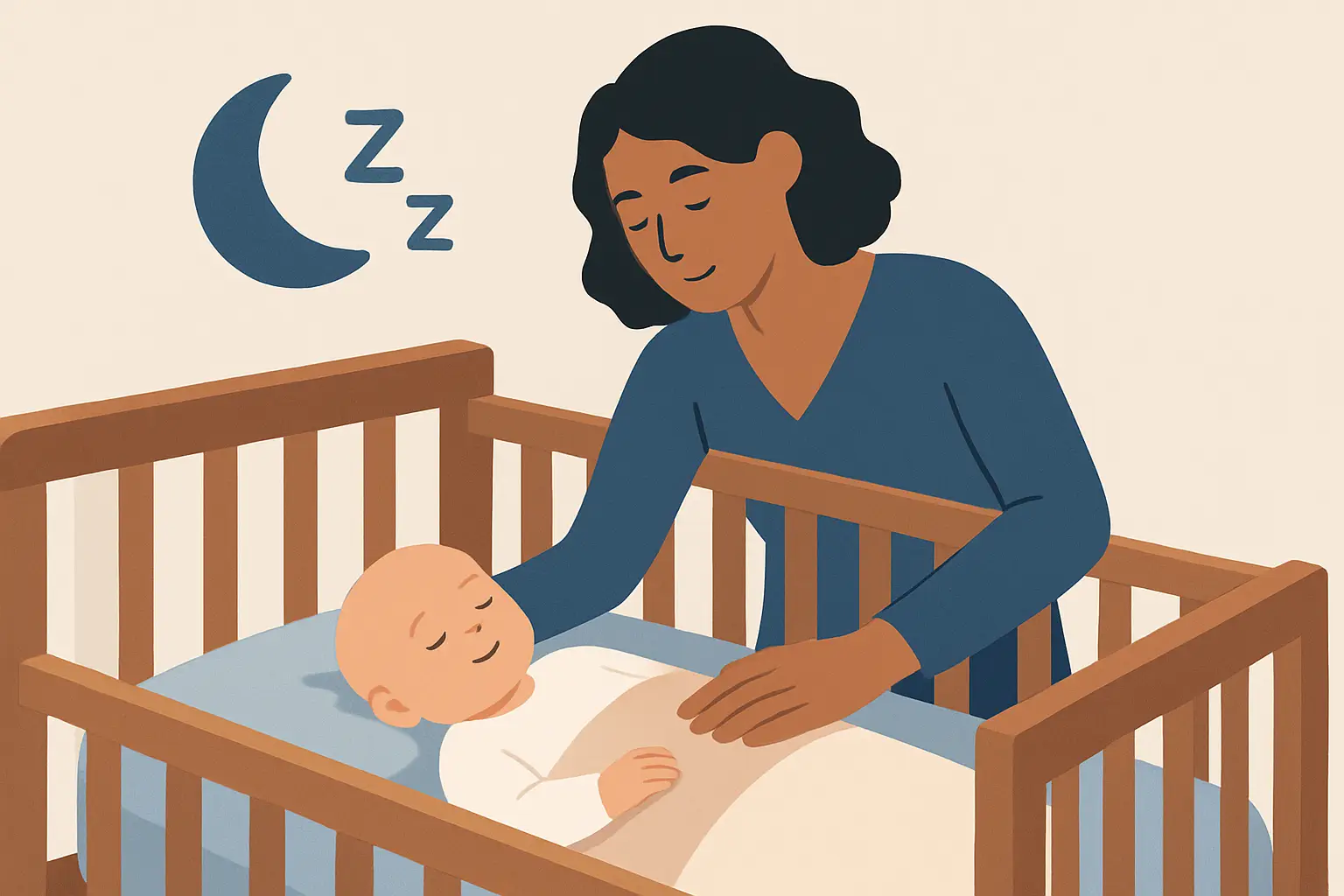
First, put baby down feet and bottom first, then shoulders, then head. This reduces the “falling” sensation that can trigger a startle. Keep one hand on their chest or tummy for a moment so they still feel contact.
Second, avoid sudden temperature changes. A cold mattress can wake a baby instantly. You can warm the cot briefly with a heat pack or hot water bottle before the transfer – but remove it completely and check the mattress is not warm to the touch before baby goes in. The cot must be safe, not cosy-at-all-costs.
Third, don’t rush your exit. After you place baby down, pause. Keep your hand in place, slow your breathing, and wait for their body to soften. Then remove your hand gradually.
Settling in the cot: pick one method and commit for a week
There are a lot of settling approaches because babies are different and families have different limits. The mistake many parents make is switching methods every night at 2 am, which teaches baby that persistence brings a brand-new strategy.
Here are three cot-based options that suit different comfort levels.
Option 1: Hands-on settling (shush-pat style)
Put baby down and stay close. Use a calm “sleepy voice” phrase you’ll repeat every time, like “It’s sleep time now, I’m right here.” Pat or rhythmically rub their tummy or chest, and use a steady shush. The aim is boring reassurance.
If baby escalates, you can pick them up to calm, then put them back down before they’re fully asleep. Repeat as needed. This can take time at first, but it’s a gentle way to build cot tolerance.
Option 2: Pick up, put down
This is structured and consistent. When baby cries, you pick them up just until calm (not asleep), then put them back in the cot. You might do this 20 times in the first nights. It’s repetitive, yes. It’s also clear: you’re responsive, and the cot remains the place where sleep happens.
This tends to work best when you can stay calm and steady. If you’re already at breaking point, choose a method that requires less stamina.
Option 3: Check-ins (graduated reassurance)
If you don’t want to stay by the cot the whole time, you can do timed check-ins. Put baby down awake, leave, then return at set intervals to reassure with voice and a brief touch, without picking up unless you feel it’s necessary.
This approach suits some families, especially when a parent hovering keeps baby more alert. It’s not for everyone. If it feels too stressful, that’s a valid reason to choose something else.
Whatever you pick, give it a proper trial. Seven nights is a useful window. Not because everything will be perfect, but because you’ll get enough data to know if it’s improving or just exhausting you.
Nights are one thing. Day naps are their own sport.
Many babies will do longer stretches at night in the cot but resist it for naps. Day sleep is lighter, the house is noisier, and sleep pressure is lower.
If naps are a battle, start with just one cot nap per day – usually the first nap, when sleep pressure is highest. Do that consistently for a week. If the nap is short, that’s still practice. You can rescue the nap with contact or pram if you need to protect overall sleep and mood.
This is one of those trade-offs where perfection backfires. A baby who is chronically overtired from “training” naps often sleeps worse in the cot at night too.
If baby only sleeps on you: how to step down gently
Contact naps and feeding to sleep are common, especially in the first months. If it’s working for you and you’re safe, you don’t have to change it just because someone on the internet said so.
If it’s not working – because you need rest, you have other kids, or it’s affecting your mental health – step down in layers. Move from feeding to sleep in your arms, to feeding then rocking, to rocking then cot settling, to cot settling with less and less help. Each step can take a few nights.
The key is to change one thing at a time. If you change feeding, the routine, the room, and the settling method all in the same week, you won’t know what helped and you’ll all be frazzled.
When the cot is in your room vs a separate room
Room-sharing can make settling easier for some babies and harder for others. If baby can see or hear you, they may wake more often and demand your attention. On the other hand, being close can reduce anxiety and make night feeds less disruptive.
If you’re room-sharing and wake-ups feel constant, try a small visual barrier (without adding anything to the cot), shifting the cot slightly further from your bed, or having the non-breastfeeding partner do the first resettle so baby isn’t immediately expecting a feed.
If you’re considering moving baby to their own room, follow safe sleep guidance for your area and do it when you can be consistent for a couple of weeks. Big changes are easier when you can commit.
What to say (to yourself and your partner) at 3 am
Sleep deprivation turns minor disagreements into relationship-defining moments. Having a script helps.
Try: “We’re both exhausted. Let’s pick the next step and do it for 10 minutes, then reassess.” Or: “You take the settling, I’ll reset the room and make a bottle, then we swap.” It keeps you out of blame and into teamwork.
If you want more stage-based parenting support that’s practical and not preachy, Kiwi Families is a solid reference point: https://www.kiwifamilies.co.nz.
When to pause and get support
If your baby is struggling to breathe, has a fever you’re worried about, isn’t feeding well, is unusually sleepy, or their cry feels markedly different, trust your instincts and seek medical advice.
For ongoing sleep challenges, extra support can be a game-changer. Some babies have reflux, allergy issues, or sensory sensitivities that make lying flat genuinely uncomfortable. Sometimes a personalised plan is what gets you out of the cycle.
The closing thought you need if this has been a long week
Your baby isn’t giving you a hard time – they’re having a hard time. Cot sleep is a skill, and like any skill it gets built through repetition, not perfection. Pick one small change you can stick with tonight, and let that be enough for now.