

In this article
- Montessori vs play based learning: the core difference
- What a Montessori setting usually looks like
- What play based learning usually looks like
- Which approach is better for school readiness?
- Montessori vs play based learning for different personalities
- Questions to ask when visiting
- Red flags parents should not ignore
- If you like parts of both, that is normal
- So how do you choose?
You can usually tell what matters to a nursery within minutes of walking in. Are the shelves low and tidy, with children quietly choosing their own work? Or is there a home corner in full swing, paint on the table, and a small group building a zoo out of blocks? That is often the real question behind Montessori vs play based learning. Parents are not just comparing teaching methods. They are trying to picture their child in the room.
The tricky part is that both approaches can sound excellent on paper. Both talk about child-led learning, independence, and development through hands-on experiences. But they are not the same, and the differences do affect day-to-day life for children and families.
Montessori vs play based learning: the core difference
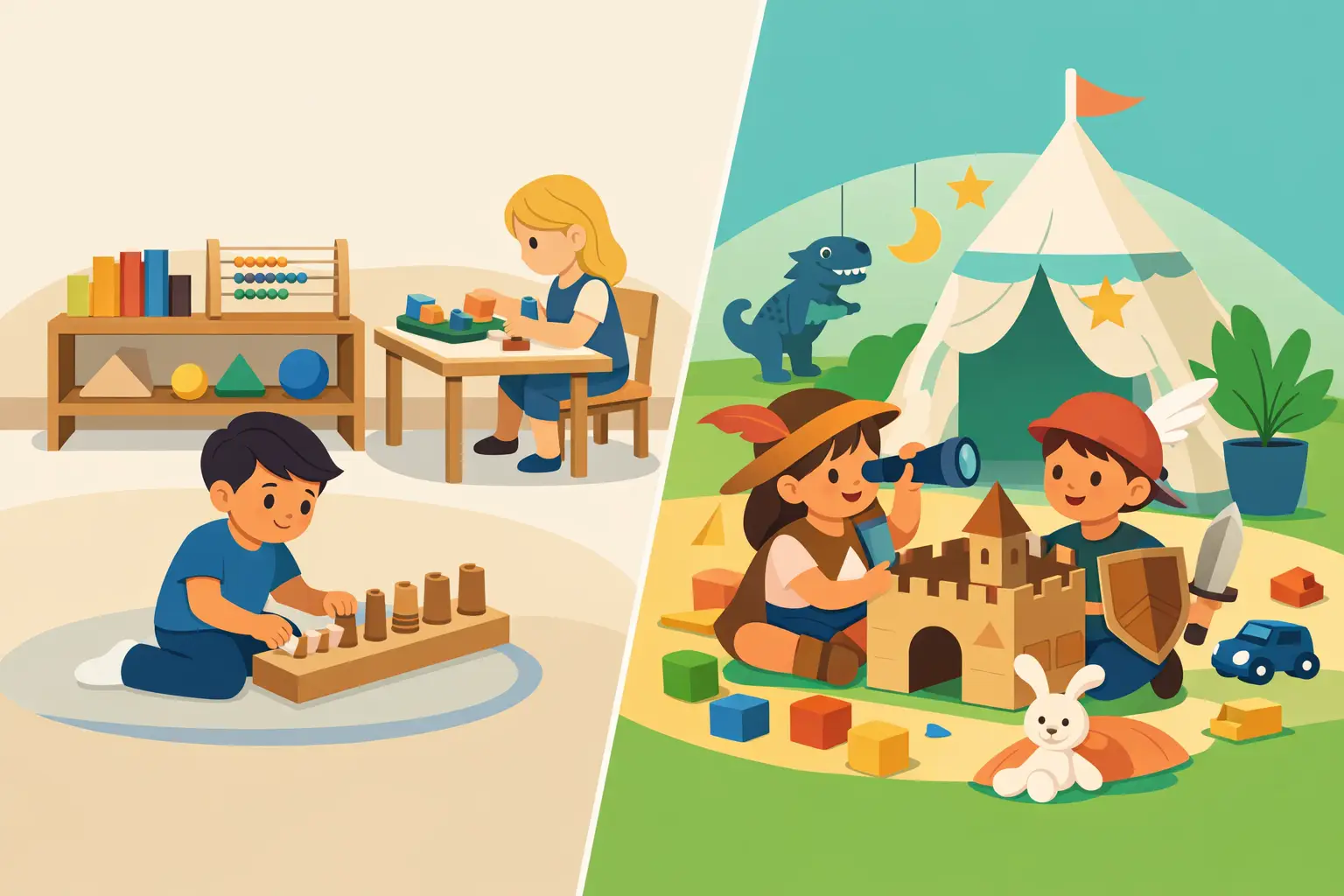
Montessori is a specific educational philosophy with a defined structure. It uses carefully designed materials, mixed-age classrooms, and a strong emphasis on independence, concentration, and practical life skills. Children are given freedom within clear limits, and the adult acts more as a guide than a traditional teacher.
Play based learning is broader. It centres on the idea that children learn best through play, exploration, conversation, and relationships. That play might be child-initiated, adult-supported, or a mix of both. A play based setting may include role play, messy play, outdoor exploration, stories, songs, and open-ended resources that can be used in lots of different ways.
So while Montessori is one distinct method, play based learning is more of an umbrella. That matters because two play based nurseries may look quite different from each other, while Montessori settings tend to have more consistency in how the environment is organised.
What a Montessori setting usually looks like
A Montessori classroom often feels calm, ordered, and purposeful. Resources are displayed neatly and children are shown how to use them in a specific way. You might see a child pouring water between jugs, polishing a mirror, matching sound cylinders, or using number rods.
None of that is random. The idea is that children build independence and confidence by working with materials designed to teach one concept at a time. They repeat tasks until they master them, and they are trusted to care for their environment.
For some children, this setup is a gift. A child who likes routine, order, and clear expectations may settle beautifully. A child who gets overwhelmed by too much noise or chaos may also thrive.
But there are trade-offs. Some parents find Montessori settings feel more structured than they expected, especially if they imagined free-flowing creativity all day. Imaginative play can be less central in some Montessori environments, and not every child is drawn to working with set materials in a quiet, focused way.
What play based learning usually looks like
A play based nursery often feels more fluid. Children might move between construction, dressing up, sensory trays, mark making, small world play, and outdoor activities. Adults observe, join in, ask questions, and extend learning through conversation and shared experiences.
This approach gives a lot of room for imagination, social development, and language. When children invent a café, build a pirate ship, or spend half an hour mixing mud and leaves outside, they are not just passing time. They are learning to negotiate, plan, problem-solve, and make sense of the world.
Play based learning can be especially strong for children who learn by doing, talking, moving, and pretending. It can also feel more natural to families who want early childhood to be rich in creativity and social interaction.
The challenge is that quality varies. In a strong play based setting, play is intentional and adults know when to step in, when to hang back, and how to spot learning in the middle of what looks like chaos. In a weaker setting, “play based” can become a vague label for not much structure at all.
Which approach is better for school readiness?
This is where parents often feel pressure, and fair enough. You do not want to choose something that sounds lovely now but leaves your child struggling later.
The honest answer is that school readiness is not owned by either approach. Children need a mix of skills before school: confidence, language, emotional regulation, curiosity, physical coordination, early literacy and numeracy foundations, and the ability to cope with routines and other people.
Montessori can support school readiness through concentration, independence, practical skills, and sequential learning. Children often get very capable at managing their belongings, completing tasks, and working on their own.
Play based learning can support school readiness through communication, collaboration, resilience, and flexible thinking. Children often practise joining groups, solving social problems, and expressing themselves in different ways.
What matters most is not the label on the prospectus. It is whether the setting is well run, emotionally secure, and matched to your child.
Montessori vs play based learning for different personalities
If your child likes order, repeats activities by choice, and gets deeply absorbed in quiet tasks, Montessori may feel like a natural fit. These children often enjoy knowing where things belong and what the expectations are.
If your child is highly social, imaginative, and learns through movement and talk, a play based setting may suit them better. These children often light up when they can invent, explore, and engage with others more freely.
That said, personality is not the whole story. A shy child might blossom in a warm play based nursery with excellent key workers. A lively child might benefit from the calmer rhythm of Montessori. Children are not fixed types, and the right environment can support growth as well as comfort.
Questions to ask when visiting
Forget the marketing phrases for a moment. The useful questions are practical.
Ask how staff support children who are upset, how they manage conflict, and what a typical morning looks like. Ask how they build language, early maths, and independence. Ask what happens if a child does not want to join an activity, and how they communicate with parents about progress.
If it is Montessori, ask how much room there is for creative and imaginative play. If it is play based, ask how staff make sure learning is intentional rather than purely reactive.
And while you are there, watch your child if they come along. Do they seem curious? Do staff speak to children with respect? Does the room feel calm enough to think, but warm enough to belong?
Red flags parents should not ignore
A beautiful environment is not enough. In any setting, be cautious if adults seem detached, impatient, or overly controlling. Be wary if children look aimless for long stretches, or if everything appears rigid and joyless.
You are looking for more than a philosophy. You are looking for emotionally attuned adults who understand child development and can balance freedom with boundaries.
This is especially important for younger children. A two-year-old does not need a perfect educational label. They need safety, connection, language, movement, and adults who notice them properly.
If you like parts of both, that is normal
Many parents feel torn because they like Montessori independence but also value messy play and imagination. That is not confusion. It is common sense.
In real life, plenty of families borrow from both approaches. You might set up low shelves, child-sized tools, and simple routines at home in a Montessori-inspired way, while also prioritising pretend play, outdoor exploration, stories, and art. Good early years practice is rarely about strict ideology.
If you are choosing a nursery or preschool, try not to get pulled into the idea that there is one correct answer for every child. There is not. There is only the setting that feels most likely to help your child feel secure, capable, and eager to learn.
So how do you choose?
Start with your child, not the trend. Think about their temperament, sensory needs, communication style, and what helps them settle. Then look at the adults in the room, because relationships will shape your child’s experience more than any brochure language.
It can also help to think about your family values. Some parents care deeply about independence and order. Others want early childhood to feel playful, expressive, and social. Most want a bit of both. Be honest about what matters to you, because that will affect how comfortable you feel with the setting over time.
If you are still unsure after visits, trust the setting that feels warm, thoughtful, and consistent. A child who feels safe and understood is in a far better position to learn than one placed in a theoretically perfect system that does not fit.
The best choice is rarely the flashiest one. It is the place where your child can be known well, challenged gently, and allowed to grow at their own pace.