
In this article
- How to teach kids to cross roads safely at different ages
- Start with the rules that do not change
- What to say when you’re teaching it in real life
- Practise in low-pressure places first
- Teach the hazards children often miss
- Independence should be earned, not assumed
- When your child is impulsive or neurodivergent
- The habit that matters most
That moment comes for every parent – your child pulls slightly ahead on the pavement, reaches the kerb, and suddenly you can feel how much trust road safety requires. If you’re wondering how to teach kids to cross roads safely, the answer is not one big talk. It’s a series of small, repeated lessons that start earlier than most parents expect.
Children do not learn road sense just by being near roads. They learn it through direct teaching, repetition, and lots of practice with you beside them. The tricky bit is that children can look confident long before they are genuinely safe. A child who knows to “stop, look, listen” may still act on impulse, misjudge speed, or forget everything the second they spot a dog, a friend, or a dropped toy.
How to teach kids to cross roads safely at different ages
Road safety teaching works best when it matches your child’s stage, not just their age on paper. Some children are naturally cautious. Others are fast, distractible, and convinced they’ve got this well before they do.
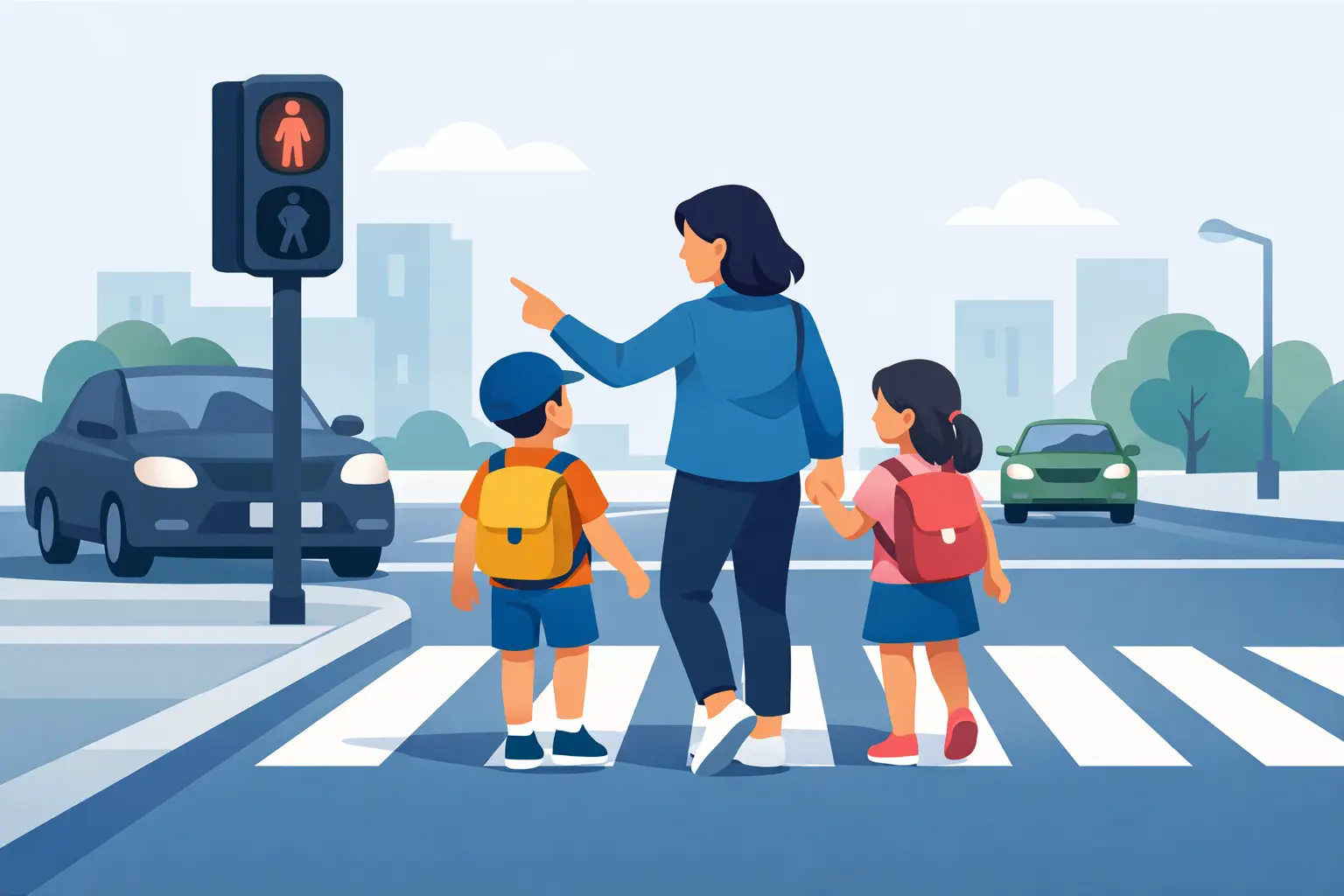
For toddlers and pre-schoolers, the priority is not independent crossing. It is habit. Hold hands near roads every time. Stop at every kerb. Use the same words again and again so the routine becomes automatic: “We stop at the kerb. We look both ways. We listen. We stay together.” At this age, short phrases beat long explanations.
For younger primary-aged children, you can begin involving them more actively. Ask questions while you walk: “Is this a safe place to cross?” “Can you hear a car coming?” “Why are we waiting?” They still need close supervision, but you’re helping them notice what you notice.
For older children, the focus shifts towards judgement. They need practice reading parked cars, driveways, junctions, cyclists, electric vehicles, and crossing lights. This is where many parents ease off too soon. A child may know the rules and still struggle to apply them consistently in real traffic.
Start with the rules that do not change
Children cope best when the core rules stay simple. Too many extras can muddy the message. The basic script should be clear and repeated often.
Stop at the kerb. Stand back from the edge. Look right, then left, then right again. Listen for traffic. Think about whether drivers can see you. Cross only when it is safe, and keep walking – don’t run, don’t stop halfway, and don’t go back for something dropped.
If there is a pedestrian crossing, use it. If there are traffic lights, teach them that a green man helps but does not replace looking. Children need to hear this plainly: lights can change, cars can turn, and not every driver pays attention.
A useful family rule is this: never cross because somebody else is crossing. Cross because you have checked and know it is safe. That matters in busy areas where adults sometimes take risks children should not copy.
What to say when you’re teaching it in real life
Most parents do not need more theory. They need words they can actually use on the school run. Keep it calm, specific, and repetitive.
You might say, “We stop at the kerb every single time,” or, “Show me where you would stand so you’re away from the edge.” If your child wants to rush, try, “Fast feet are for the park. Near roads, we use careful feet.” If they assume a crossing is automatically safe, say, “The crossing helps us, but we still check for cars ourselves.”
When they get it right, name exactly what they did well. “You stopped before the kerb and kept looking while we crossed. That’s what safe crossing looks like.” Specific praise helps the lesson stick better than a vague “good job”.
If they get it wrong, avoid turning it into a dramatic scare lecture unless there has been a genuine near miss. A calm correction usually lands better: “You stepped forward before we had checked properly. Let’s go back and do it again.” The goal is not fear. The goal is reliable behaviour.
Practise in low-pressure places first
If you want to know how to teach kids to cross roads safely without overwhelming them, start where the traffic is light and the pace is slow. Quiet residential streets are better than a busy high street. Children learn more when they have space to think.
Walk the same route several times and talk through what you’re doing. Then gradually hand over parts of the process. First they identify the kerb. Then they choose a safer place to cross. Then they tell you when to wait and when to go. You are still in charge, but they are practising the decision-making in manageable chunks.
This step-by-step approach matters because road crossing is not one skill. It is several skills at once – attention, impulse control, listening, visual scanning, distance judgement, and timing. Some children pick up one part quickly and struggle with another. That is normal.
Teach the hazards children often miss
Adults forget how much of road safety is invisible to a child. Children often focus on the nearest obvious car and miss the more complex risks around them.
Parked cars are a major one. They block sight lines, hide reversing vehicles, and create the temptation to step out between gaps. Teach children that crossing between parked cars is not safe unless there is no alternative and an adult is directly managing it. Even then, the better lesson is to walk to a place with a clearer view.
Driveways are another blind spot. Many children treat them like part of the pavement. Explain that cars can reverse out quietly and quickly, and some newer vehicles are much harder to hear. Electric cars and bikes make listening important, but not enough on its own.
Weather changes things too. Rain, dark afternoons, and glare can reduce visibility for both your child and drivers. On those days, narrate the extra caution: “It’s harder to see today, so we wait longer and make sure the driver has really stopped.”
Independence should be earned, not assumed
A common parent trap is linking road independence to school year rather than actual readiness. Plenty of children can recite safety rules and still are not ready to cross roads alone. That does not mean they are behind. It means road judgement is still developing.
Before allowing more independence, watch for consistency over time. Can your child stop automatically without being reminded? Do they stay focused rather than chatting, swinging a bag, or drifting ahead? Can they spot hidden hazards such as a car indicating to turn? Do they make the same safe choices when they are excited, tired, or in a hurry?
It also depends on the route. A child who manages a quiet cul-de-sac may not be ready for multi-lane traffic, busier junctions, or roads near shops and schools where vehicles move unpredictably. Independence is route-specific as much as child-specific.
If your child is beginning to walk short stretches ahead or travel with friends, set non-negotiables. They use crossings where available. They keep mobile phones away. They do not run across because somebody is calling them. And if the situation feels confusing, they wait.
When your child is impulsive or neurodivergent
Some children need more repetition, more structure, and more direct supervision for longer. That includes many children with ADHD, autism, developmental delay, or sensory processing differences. Standard advice may not be enough because the challenge is not understanding the rule – it is applying it consistently in a stimulating real-world setting.
In those cases, visual prompts, repeated routes, and very explicit scripts can help. So can practising at the same crossings until the routine becomes familiar. Keep instructions concrete: “Stop with your toes behind this line,” or, “Tell me three things you need to check before we move.”
If your child is highly impulsive, treat road safety as a skills-in-progress issue, not a behaviour flaw. More maturity may come with time, but for now your management matters. Hands may still need to be held. Distances may need to stay shorter. That is not overprotective. It is sensible.
The habit that matters most
Children copy what they see under pressure, not what they hear during a calm chat in the kitchen. If you cross while distracted, step into the road before checking properly, or wave them across from the other side, that becomes part of their learning.
The strongest road safety lesson is your own consistency. Stop fully. Check properly. Use crossings. Stay off your mobile phone. Let them see that even adults do not take shortcuts near traffic.
No child learns this in a weekend. You are building judgement slowly, one ordinary walk at a time. Keep the language simple, keep the routine steady, and keep practising longer than feels necessary. That is usually where real confidence begins.