

In this article
- When to start talking about first period
- How to talk about first period in a way that actually lands
- Keep it factual, but not clinical
- Scripts for awkward moments
- What your child needs to know before it starts
- Prepare the practical side without making it a big performance
- If your child is embarrassed, shut down, or says “I know”
- What not to do
- When first period arrives
- This conversation is bigger than periods
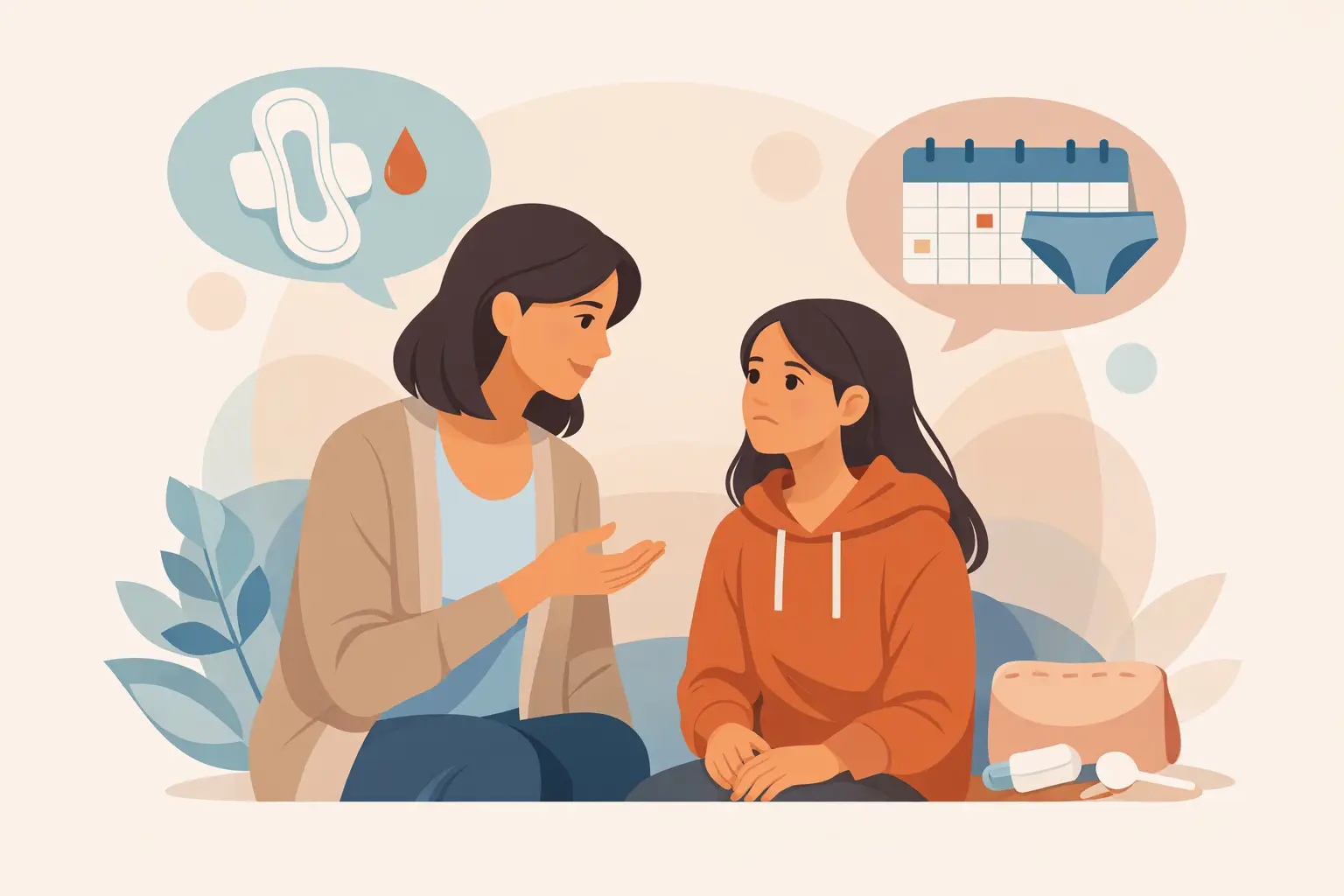
That moment sneaks up on a lot of parents. One minute you are buying bigger school shoes, the next you are wondering how to talk about first period without making your child cringe, panic, or shut the conversation down completely.
The good news is you do not need a perfect speech. You do not need to know every answer on the spot either. What matters most is that your child hears one clear message from you early and often: periods are normal, they can feel a bit messy at first, and they do not have to deal with it alone.
When to start talking about first period
Earlier than many parents think.
A lot of children start puberty before adults expect it, and first periods can happen as young as eight or nine, even though the average age is later. That means waiting until your child looks older or starts secondary school can leave the conversation too late. If they have already started breast development, body odour, pubic hair, or are asking questions about pads, it is definitely time.
But even without visible signs, it helps to start the basics in primary school. Think of it less as one big talk and more as a series of short, ordinary conversations. That takes the pressure off both of you.
If your child already has a first period before you have spoken properly, try not to spiral into guilt. You can still steady things quickly by staying calm and matter-of-fact. Your response in that moment matters more than whether you got the timing exactly right.
How to talk about first period in a way that actually lands
Children usually cope better when adults are clear, simple, and not overly intense. If you build the topic up like a major life event, they may assume it is something scary or embarrassing. If you brush it off too much, they may feel confused or underprepared.
Aim for calm, honest, and age-appropriate.
You might say, “At some point your body will start doing something called a period. It means your body is growing up. It can feel strange at first, but lots of girls and some non-binary young people have them, and I’ll help you know what to do.”
That kind of language does a few useful things at once. It names what is happening, explains that it is normal, and makes it clear they will have support.
Try to avoid dramatic phrases like “becoming a woman” with younger children, especially if they are still emotionally very much a child. For some kids, that language feels too big and confusing. A first period means their body is changing. It does not mean they are suddenly mature, grown, or ready for adult expectations.
Keep it factual, but not clinical
Children need enough information to make sense of what is happening in their body. They do not need a biology lecture unless they ask for one.
Start with the practical explanation. You could say, “Each month the body gets ready in case of a pregnancy one day in the future. If there is no pregnancy, the lining comes away as blood through the vagina. That is called a period.”
Then move quickly to what they probably want to know most. Will it hurt? How much blood is there? What if it happens at school? What do I wear? Who do I tell?
Those questions matter because children often worry less about the science than about being caught out in public.
You can say, “It usually looks like more than it is. Some people get cramps or feel tired, and some do not. If it starts at school, you can use a pad and tell a teacher, school nurse, or the office. We can pack supplies so you’re ready.”
That is the sweet spot – accurate, reassuring, and useful.
Scripts for awkward moments
A lot of parents know what they believe but freeze when it comes to actual words. Having a few ready-made lines helps.
If your child asks, “Will I get a period soon?” you can say, “Maybe not yet, maybe soon. Bodies all do this in their own time, so we’ll make sure you know what to expect before it happens.”
If they say, “That sounds gross,” try, “It can definitely feel messy sometimes, but it is a normal body function. We can talk about how to manage it so it feels less overwhelming.”
If they say, “I do not want this to happen,” a good response is, “That makes sense. A lot of people feel unsure about changes in their body. You do not have to like it, but you will learn how to handle it.”
If they ask, “Does everyone get it?” be honest: “Most girls do, and some non-binary or trans young people do too, depending on their body. Not everyone’s experience is the same.”
These small responses send a bigger message: no shame, no panic, no silly questions.
What your child needs to know before it starts
Before a first period arrives, they should know what blood might look like, where it comes from, and that it may not be bright red every time. Brown spotting can happen too. They should know how to use a pad, how often to change it, and how to wrap and bin it.
They also need a plan for everyday life. Show them where pads are kept at home. Put a couple in their school bag. If they are staying at another house, explain that they can tell the adult there or message you. If school is the big worry, name the safe adults they can go to.
This is also the time to talk about tracking. Early periods can be irregular, so do not promise a perfectly predictable monthly cycle. It is better to say, “At first it might come at odd times, and that is common. We can keep an eye on it together.”
Prepare the practical side without making it a big performance
A small first period kit can make a child feel much more in control. Keep it simple: pads, spare underwear, a small sealable bag, wipes if your child’s school allows them, and maybe pain relief for home use if needed.
There is no need to turn it into a giant puberty ceremony unless your child would genuinely enjoy that. Some children love a fuss. Others would rather crawl under the sofa than have a “special chat” with snacks and a gift bag. Follow their personality, not social media.
The same goes for products. Pads are usually the easiest starting point, but not every child likes the same style. Some prefer thinner pads, some want wings, some are interested in period pants later on. It can take trial and error.
If your child is embarrassed, shut down, or says “I know”
That is normal too.
Some children can only handle this topic in tiny bursts. If face-to-face chats feel too intense, try talking while walking the dog, driving, or folding washing. Side-by-side conversations are often easier than direct eye contact.
You can also keep the door open without forcing it. Say, “You do not need to talk about this right now, but I want you to have the basics and know you can always ask me later.”
A child who says “I know” may know some things from school, friends, TikTok, or older siblings. That does not mean they know the useful bits or that the information is accurate. Instead of challenging them, try, “Fair enough. Tell me what you’ve heard, and I’ll fill in any gaps.”
That approach respects their growing independence while still letting you correct myths.
What not to do
Do not wait for an obvious perfect moment. It rarely arrives.
Do not lead with your own horror story unless it genuinely helps. Telling your child you bled through your PE kit in Year 7 may make them laugh, but it may also increase anxiety if the message becomes “this is a disaster waiting to happen”.
Do not make jokes at their expense, announce it to relatives, or treat their body as public family news. Privacy matters. Some children are open about periods. Others want this kept very quiet. Ask what they are comfortable with.
And do not assume one conversation has covered it. Puberty is a moving target. What made sense at nine may need revisiting at eleven.
When first period arrives
If the moment comes and your child is upset, your calm is the anchor.
Start with the basics: “You are okay. This is your first period. Let’s get you cleaned up and comfortable.” Then help with fresh underwear, a pad, and simple instructions. Keep your tone steady.
Later, once things have settled, you can explain a bit more and ask how they are feeling. Some children are proud. Some are tearful. Some are annoyed because it interrupted a normal day. All of those reactions are fine.
If the bleeding seems extremely heavy, the pain is severe, or your child looks faint or unwell, seek medical advice. Most first periods are manageable, but it is worth trusting your instincts if something seems off.
This conversation is bigger than periods
When you handle periods with honesty and calm, you are teaching more than pad logistics. You are showing your child that bodies are not shameful, that health topics can be discussed at home, and that growing up does not have to be lonely.
That matters later, when the conversations get bigger and trickier – puberty, relationships, consent, contraception, body image. A child who has learned that you can talk plainly about a first period is more likely to come to you with the next hard question too.
You do not need a flawless script. You just need to be the safe adult who starts, listens, and stays available. For most children, that is what they will remember.