

In this article
One day your baby is happily living on milk feeds, and the next everyone has an opinion about avocado, baby rice and whether purées are “best”. If you are wondering how to introduce solids safely, the good news is that it does not need to be complicated. What matters most is timing, supervision, and keeping expectations realistic while your baby learns a completely new skill.
Starting solids is not just about nutrition. It is also about development. Your baby is learning how to sit, hold food, move it around their mouth, swallow safely and notice when they are hungry or full. That means the safest approach is rarely the fastest one.
When to start solids
Most babies are ready for solids at around 6 months. Before then, breast milk or infant formula provides what they need, and starting too early can make feeding harder rather than easier. A baby who is not developmentally ready may struggle to move food safely in their mouth.
Look for signs of readiness rather than focusing only on a date in the calendar. Your baby should be able to hold their head steady, sit upright with support, show interest in food, and open their mouth when food is offered. They should also be losing the tongue-thrust reflex that pushes food straight back out.
Wanting more milk, waking at night or watching you eat does not automatically mean your baby is ready for solids. Those things can happen for all sorts of reasons. If in doubt, speak with your GP, health visitor or Plunket nurse.
How to introduce solids safely at the start
The first few weeks are about practice, not portion sizes. Start once a day when your baby is calm and alert, not overtired and ravenous. Offer a small amount, just a few spoonfuls or a couple of soft pieces, and let them set the pace.
Milk feeds still do the heavy lifting at this stage. Solids gradually increase over time, but breast milk or formula remains an important source of nutrition through the first year.
You do not need a perfect feeding schedule. Some babies take to solids quickly. Others look deeply offended by courgette for two weeks and then suddenly get on board. Both can be normal.
Purées or finger foods?
This is where parents often feel pushed into camps. In reality, you do not have to choose one method forever. Smooth purées, mashed foods and soft finger foods can all have a place.
Purées can be useful when your baby is just getting used to swallowing something other than milk. Soft finger foods can help babies practise chewing, gripping and self-feeding. Many families use a mix, which is often the most practical answer.
The safety question is less about style and more about texture. Food should be soft enough to mash easily between your fingers. Hard, round, sticky or chunky foods are where the risk rises.
Best first foods to try
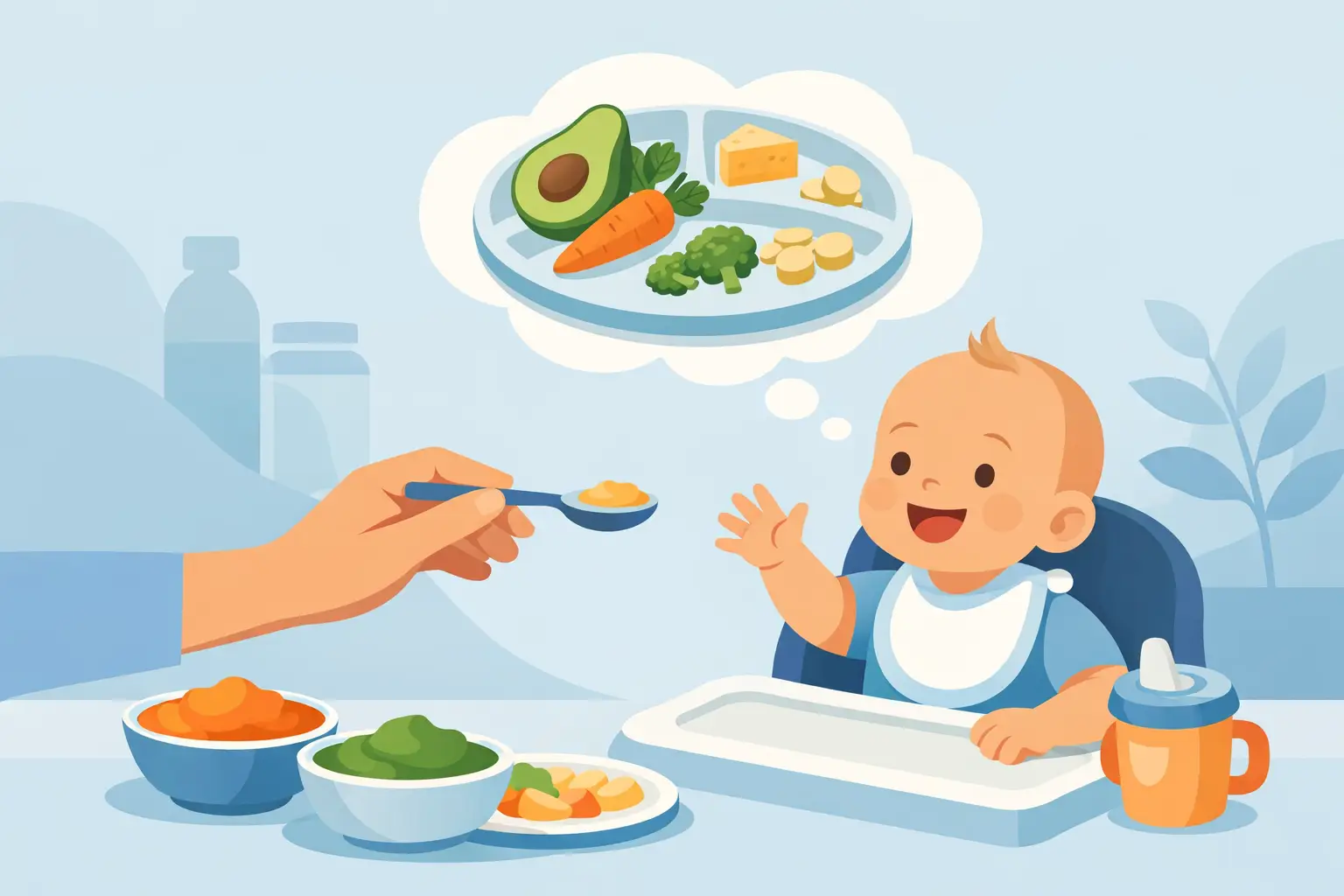
Simple is usually easier. Good first foods include mashed or soft-cooked vegetables like carrot, pumpkin, sweet potato and broccoli, as well as soft fruit such as banana, pear or avocado. Plain yoghurt, well-cooked porridge and mashed lentils can also work well.
Iron matters from around 6 months, so include iron-rich foods early. That might mean smooth meat purée, soft shredded meat, mashed beans, lentils or iron-fortified baby cereal. Babies need more than fruit and veg alone once solids begin in earnest.
Try one or two foods at a time so you can notice what your baby enjoys and how they cope. You do not need to follow an old-fashioned order of foods. There is no nutritional prize for starting with baby rice if your baby prefers soft kumara and plain yoghurt.
Foods to avoid or change
Some foods need more care. Whole nuts are a choking hazard, but smooth nut butters can be offered in a thin layer or stirred into yoghurt. Whole grapes, cherry tomatoes and blueberries should be squashed or cut appropriately. Hard raw apple, popcorn and chunks of cheese are not good early choices.
Honey should be avoided before age one. Cow’s milk can be used in cooking, but it should not replace breast milk or formula as a main drink before one. Limit foods high in salt or sugar. Babies do not need sugary snacks, salty crisps or heavily processed foods marketed as treats.
Allergens: don’t leave them until later
Parents are often nervous about allergy foods, and fairly so. But current advice has shifted. Delaying common allergens does not prevent allergies, and in some cases early introduction may help.
Common allergens include egg, peanut, cow’s milk, wheat, soy, sesame, fish and shellfish. These should be introduced one at a time in small amounts when your baby is well, ideally during the day so you can watch for a reaction.
A good example is smooth peanut butter thinned with warm water, breast milk or formula, or well-cooked egg mashed into another food. If your baby tolerates an allergen, keep offering it regularly. A food tried once and then forgotten for three months is not especially helpful.
If your baby has severe eczema, a known food allergy, or an immediate family history of allergies, talk to a health professional before introducing high-risk allergens. That is not panic territory. It is just sensible planning.
What an allergic reaction can look like
Mild reactions can include hives, redness around the mouth, vomiting or swelling of the lips or face. A severe allergic reaction is an emergency. Call emergency services if your baby has trouble breathing, becomes floppy, wheezy, pale or very unwell after eating.
Choking prevention matters more than fancy recipes
If there is one part of how to introduce solids safely that deserves your full attention, it is choking prevention. Gagging and choking are not the same thing. Gagging is common when babies learn to manage texture. It can look alarming, but it is usually noisy and your baby is still moving air.
Choking is different. It may be silent or accompanied by weak sounds, and your baby may struggle to breathe. That is why an adult needs to be present and paying attention whenever a baby eats.
Sit your baby upright for all meals. Avoid feeding in a reclined bouncer, car seat or on the move in a pushchair. Stay close, keep the environment calm, and do not put food in their mouth when they are laughing, crying or crawling around.
Cut and prepare food carefully. Round foods need altering. Firm foods need cooking until soft. Spoonfuls should be small. Nut butters should not be offered in thick blobs. Sausages and similar processed meats can also be risky if served in coin shapes.
It is also well worth learning infant first aid. Most parents hope never to use it, but knowing what to do changes the whole feeling around mealtimes. Calm is easier when you have a plan.
What to say if family members pressure you
Starting solids seems to attract commentary. You may hear that your baby needs solids early to sleep better, or that certain foods are “too strong”, or that spoon-feeding is the only safe option. Sometimes the most useful parenting skill is a polite, boring sentence.
Try: “We are following readiness signs and keeping it simple.” Or: “We are introducing foods one at a time so we can spot any issues.” You do not need to defend every spoonful.
Mess, refusal and mixed signals are part of the job
A lot of safe feeding is about not forcing things. Babies touch, smear, spit and drop food because that is how they learn. Refusing broccoli today does not mean a lifelong vendetta against green vegetables.
Keep offering a range of foods without pressure. Let your baby stop when they seem full. Signs can include turning away, clamping their mouth shut, getting distracted or pushing food away. Responsive feeding is not a soft option. It helps babies learn to trust their own hunger and fullness cues.
If your baby seems consistently distressed by eating, coughs a lot with textures, is not gaining weight, or you are worried about swallowing, get advice sooner rather than later. Sometimes a feeding issue needs more than time.
A simple routine that works
In real family life, the easiest routine is often the one you can repeat. Start with one meal a day, then build to two and three as interest and intake increase. Offer solids after or between milk feeds when your baby is settled. Choose a time when you can actually sit and watch, rather than balancing dinner prep, a Teams call and an older child asking for a lost PE kit.
You do not need an Instagram-worthy tray. A bib, a spoon, a suitable seat and food prepared safely are enough. Kiwi Families readers already know this, but it is worth saying anyway: practical beats perfect every time.
There is a short window where feeding can feel oddly high stakes. You are juggling nutrition, safety, routine and a tiny human who may fling porridge into their own eyebrow. Take the long view. A calm, supervised start gives your baby room to learn, and gives you space to trust that this gets easier with practice.