

When your child has a raised temperature, it can also raise your levels of concerns. Should you take them to the doctor? Should you give them medicine? At what stage? And how much?
Recent New Zealand guidelines recommend that fever has a purpose as it helps your child fight the infection1. The body’s natural response is to raise the core temperature to help ‘kill off’ the virus or bacteria.
So rather than automatically reaching for pain and fever medicine, the latest advice in most instances is to ‘treat the child, not the fever’2. In other words, to make your child as comfortable as possible and let the fever do its job.
If your child is miserable because of the infection, then a dose of paracetamol may help them to feel more comfortable.
What is a fever1,3?
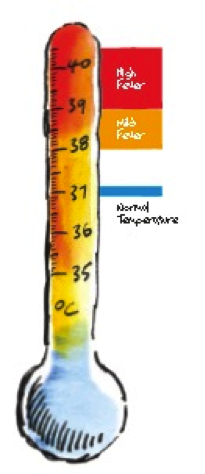
A high fever is usually over 39°C.
A normal temperature is around 37°C.
A mild fever is usually between 38-39°C.
Will a fever harm my child1?
In most cases, no. A fever on its own doesn’t mean your child is seriously sick. They may feel a little miserable or uncomfortable, but a high temperature is very unlikely to cause any permanent harm.
However, there are exceptions. If your child looks unwell and you’re worried, take them to a doctor whether they have a fever or not. You should also see your doctor if the fever lasts for more than two days.
Or if your child has seen a doctor but is not improving or is getting worse, you should go back for another check (a high temperature following a virus may indicate a secondary bacterial infection such as earache or bronchitis).
What about fever in babies1?
Young babies (less than three months old) need more careful treatment, as they can’t control their body temperatures as well as an older child can.
Fever is rare in babies under six months of age and can be a sign of serious illness or infection. If your baby has a fever, seems unwell or even if you’re not sure, always see a doctor urgently.
Handy fever relieving tips:
- Reduce your child’s layers of clothing to just a single layer (e.g. singlet and nappy/pants).
- Make sure the room is not too warm.
- Keep up fluids, and ensure your child rests.
- A bath or shower to cool your child down is not recommended.
- Giving paracetamol (such as Pamol®) is the recommended first line medicine for treatment of pain and fever for children1. Pamol’s handy Little Helper tool can help you work out the correct dose for your child.
- You may give Pamol® every four to six hours if required, but no more than four doses within 24 hours.*
- Do not routinely combine paracetamol and ibuprofen medicines unless advised to do so by your doctor4.
Always read the label and follow the pack directions on medicines and treatments for your children, and ask your pharmacist or doctor if you are unsure about any medicine.
Need further advice?
You can call Plunketline on 0800 933 922 or Healthline on 0800 611 116, toll-free, 24 hours a day.
You’ll also find more helpful tips and advice for treating fever at pamol.co.nz.
References: 1. www.kidshealth.org.nz guidelines, endorsed by the Paediatric Society of NZ, accessed 25 Feb 2014. 2. Sullivan JE, Farrar HC. Fever and antipyretic use in children. Paediatrics. 2011; 127 (3): 580-7. 3. Ministry of Health NZ website accessed 3 February 2014, www.health.govt.nz/your-health/conditions-and-treatments/diseases-and- illnesses/fever/fever-children. 4. Non-steriodal Anti-inflammatory Drugs (NSAIDs): making safer choices. BPJ Issue 55, Oct 2013.
PAMOL® for the treatment of child pain and fever. Pamol® contains paracetamol 250mg/5mL. Always read the label and use as directed. Incorrect use can be harmful. If symptoms persist see your healthcare professional. ® Registered Trademark. Aspen Pharmacare C/- Healthcare Logistics, Auckland, TAPS PP5132.
This post was sponsored by PAMOL®.