

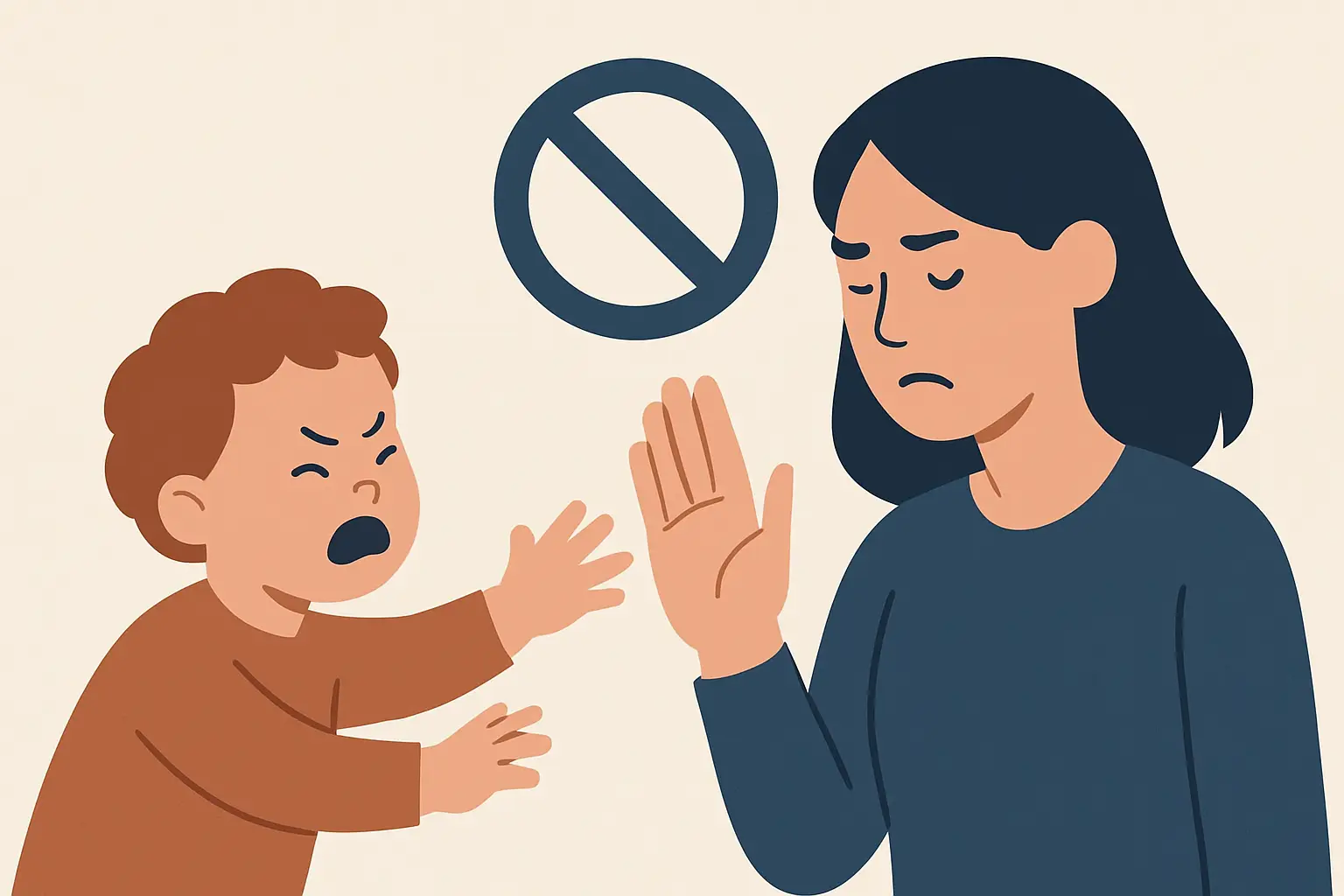
The hit usually comes out of nowhere. One second you are pouring the cereal, the next your toddler has whacked you (or their sibling) and is looking at you like they have just discovered gravity. You are not failing. You are seeing a small person with big feelings and limited skills reach for the fastest tool they have.
If you are searching for how to stop toddler hitting, the most effective approach is not a clever consequence or a perfectly worded lecture. It is a consistent, boringly predictable sequence: block, name the boundary, give a safe alternative, and then follow through every time. It works because toddlers learn through repetition, not reasoning.
Why toddlers hit (and why it can get worse fast)
Hitting is usually a communication problem, not a character problem. Toddlers hit when they are overwhelmed, when they cannot get your attention quickly enough, when they are experimenting with cause and effect, or when they are copying what they have seen. Sometimes it is pure sensory seeking: the feedback of impact is intense and interesting.
It can also escalate because it works. If hitting instantly gets a big reaction, a toy handed over, a sibling pushed away, or an adult rushing in, your toddler has learned that hitting is an efficient strategy. That does not mean you should go blank or ignore it. It means the response has to be calm, immediate, and consistent, without turning into accidental “reward”.
A quick age note: at 12-24 months, hitting is often impulsive and exploratory. At 2-3 years, it is more likely tied to frustration, power struggles, and social conflict. At 3-4 years, it can become a learned pattern if it has not been interrupted firmly.
How to stop toddler hitting in the moment
When the hit lands, you do not need a big speech. You need a reliable routine your child can predict.
First, get everyone safe. Move your body back, step between children, or gently hold your toddler’s wrists at their sides if they are mid-swing. Keep your face calm. If you look shocked or furious, some toddlers will repeat the behaviour just to see what happens next.
Then deliver the boundary in one short line. Think: fewer words, lower volume, slower pace. Try: “I won’t let you hit.” That line matters because it communicates protection and certainty, not negotiation.
Next, give an alternative that meets the same need. If they are angry, they can stamp, squeeze a cushion, or push their hands into the sofa. If they want your attention, they can tap your arm and say “Mummy, help.” If they want the toy, they can say “turn please” or “my go”. You are not excusing the hit. You are teaching the replacement behaviour.
Finally, follow through with a small, immediate consequence that is about stopping the behaviour, not punishing the child. This often means separating. “Hitting means you are away from me.” Or: “Hitting means play stops.” If they hit a sibling, remove the hitter first, not the sibling. It avoids teaching “if you hit, the other child disappears”.
If your toddler melts down when you enforce the boundary, that is not proof it is not working. That is proof they wanted a different outcome. Stay close, keep them safe, and keep the limit.
What to say: scripts you can use on repeat
Use the same phrases every time. Toddlers thrive on repetition.
When they hit you: “Ouch. I won’t let you hit me. Hands are for helping. You can say: ‘Mummy, help.’”
When they hit a sibling: “Stop. I won’t let you hit. You’re having a hard time, so I’m moving you here. When you’re ready, you can try again with gentle hands.”
When they hit over a toy: “I won’t let you hit. If you want it, say ‘my turn’. I’ll help you wait.”
When you are about to lose it: “I need a moment. I’m keeping you safe.” (Then breathe, lower your shoulders, and speak slower.)
What not to do (even if it feels satisfying)
There are a few common responses that can backfire, especially with strong-willed toddlers.
Hitting back or “showing them how it feels” teaches exactly the opposite lesson: that hitting is a valid tool when you are bigger or angrier. Yelling can also escalate the nervous system and turn a quick correction into a full-body meltdown. Long lectures usually become background noise.
It also helps to avoid asking questions you do not want answered. “Are you going to stop hitting?” invites a toddler to say “No” just to test you. A statement works better: “Hitting stops now.”
The hidden fuel: tiredness, hunger, and chaos
If hitting is happening daily, look at the boring basics first. Toddlers are brutally honest barometers of sleep debt, hunger, and overstimulation.
Notice the timing. If it reliably happens at 5pm, you may be dealing with a child who cannot cope with the dinner rush. A snack, an earlier meal, a calmer transition from nursery, or a predictable quiet activity can reduce the number of “flashpoint” moments you have to manage.
Also check whether your toddler is being asked to share beyond their developmental capacity. Toddlers can take turns with support, but “share nicely” as a blanket instruction is vague. Your job is to scaffold: “You can have it for two minutes, then it’s Sam’s turn. I’ll set the timer.”
Teach the skill when everyone is calm
Toddlers do not learn new skills mid-tantrum. They practise them in the calm moments, then you prompt them during conflict.
Pick one replacement behaviour at a time and make it ridiculously easy. If your toddler hits for attention, teach a simple script: “Mummy, play.” Practise it when you are already playing. If they hit when you say no, teach “I’m cross” with a matching gesture (hand on chest, stamp). If they hit when they want a toy, teach “turn please” and step in fast to support waiting.
Role play for 30 seconds, not ten minutes. Use dolls, teddies, or cars. “Teddy wants the block. Teddy says ‘turn please’. Teddy waits. Now Teddy gets a turn.” That kind of tiny rehearsal pays off.
Make your boundary physically real
Some toddlers need the limit to be tangible. Words alone are too abstract.
If hitting is frequent, plan your environment for the phase you are in. Keep play in the same room as you when possible. If siblings are being targeted, create protected spaces: a baby gate, a playpen, or a “big kid” table where small hands cannot reach. This is not about restricting your toddler forever. It is about preventing repeated incidents while you teach a new habit.
At childcare, ask how they respond and aim for similar language at home. Consistency across adults accelerates learning.
If your toddler hits at nursery or playgroup
This is where parental shame loves to show up. Try to treat it like data.
Ask three practical questions: What happened right before the hit? What did the adults do immediately after? What happened to the other child? You are looking for patterns, not blame.
Then share your home script with staff and ask them to use the same short boundary line if they can. Something like “I won’t let you hit” is clear and neutral. If everyone is saying something different, toddlers get mixed messages and the behaviour can linger.
If you want more stage-based behaviour guidance like this, Kiwi Families has a deep library organised by age and need, which is handy when you are troubleshooting under pressure.
When it’s more than a phase
Sometimes hitting is persistent because the underlying need is bigger. Consider extra support if:
- Hitting is intense, frequent, and not improving with consistent boundaries over several weeks.
- Your toddler seems unusually impulsive, constantly dysregulated, or struggles across settings (home, nursery, grandparents).
- There are developmental concerns around speech, hearing, or sensory processing.
- You are seeing other aggressive behaviours like biting, headbutting, or deliberate hurting of animals.
In those cases, start with your GP or health visitor. Hearing issues, language delays, sleep problems, and neurodivergence can all change what “best practice” looks like. The goal is not a label. It is the right support.
The part nobody says out loud: you can be triggered too
Toddlers are small, but hitting can feel deeply disrespectful and personal, especially if you are stretched thin or carrying the mental load solo. If you notice yourself snapping, build a micro-plan for the moment after the boundary.
Put your child somewhere safe for 30 seconds (cot, high chair, behind a stair gate) and regulate yourself. Cold water on wrists, three slow breaths, unclench your jaw. You are not “taking a break from parenting”. You are modelling that bodies can calm down without hurting.
Here is the honest trade-off: a calm response can feel slower than shouting. But it is faster over the long run, because it teaches the lesson you actually want – that strong feelings are allowed, and hurting people is not.
If you keep one thought in your pocket this week, make it this: your toddler is not giving you a hard time, they are having a hard time – and you can be both kind and very firm at the same time.