

In this article
Last updated: 10 June 2026
The quick version
- Matariki 2026 is on Friday July 10th. Most schools and whānau celebrate the week before and after.
- The simplest crafts for under-5s: paint and glitter stars, slime, tin can lanterns.
- The most meaningful for 6+: weaving harakeke whetū, making delta kites, building a Matariki star wall.
- You only need supplies you likely already have — paper, paint, glue, glitter, recycled jars and cans.
- Pair the craft with the story. Each star in the cluster has a name and a meaning. That’s what makes it Matariki, not just a craft hour.

Matariki is the small cluster of stars Western astronomy calls the Pleiades. In Aotearoa, when this cluster reappears in the pre-dawn winter sky, Māori mark the start of a new year.
It’s a time for remembering those we’ve lost, celebrating the present, and looking ahead to the year to come.
For families with young children, Matariki is also a wonderful invitation to slow down, light a fire, look up at the sky, and make something together with your hands.
The crafts below range from quick afternoon projects for preschoolers to thoughtful weaving sessions that work beautifully in school classrooms. Each one is paired with a short note on which age it suits best and what materials you’ll need.
If you want a deeper introduction to Matariki itself — the names of the stars, what each one represents, and how the celebration has been revived as a public holiday — read our companion guide on Matariki and the Māori New Year first.
When is Matariki 2026?
Matariki 2026 is observed as a public holiday on Friday July 10th.
The exact date moves each year because it follows the maramataka — the Māori lunar calendar — rather than a fixed Gregorian date. The Tāhuhu Mātauranga Matariki Advisory Group publishes the official dates a few years ahead.
For families, this means most Matariki crafting and celebrating happens across the two weeks bracketing that Friday — usually starting at kura the week before, peaking on the long weekend, and trailing into the following school week with classroom activities.
Many local councils and marae run free public Matariki events during this window. The official Matariki Festival website lists what’s on in each region.
9 Matariki crafts to try with your tamariki
1. Matariki Southern Lights art project

Ages 5+ · Materials: black paper, chalk pastels or oil pastels, white pencil.
The Matariki Southern Lights art project is the most-loved craft we publish for this time of year, and for good reason.
It’s simple enough that a five-year-old can do it, but the finished piece looks genuinely beautiful — a streaky aurora of green and purple chalk pastel rising from a dark horizon, with a small cluster of white-pencil stars in the sky above.
It works as a single afternoon project at home, or scales up beautifully for a classroom of 25 with minimal supplies. Allow about 45 minutes.
2. Matariki-inspired upcycled jewellery holder

Ages 6+ · Materials: empty jar or tin, paint, star embellishments, twine.
For tweens and older primary children who are starting to collect small treasures, this Matariki-inspired jewellery holder is the perfect way to combine a craft session with a gift they’ll actually use.
The star motif keeps it tied to Matariki, but the finished object lives on long past the season.
This is also a lovely one to give as a Matariki gift to grandparents or aunties — the holiday traditionally includes giving and sharing.
3. Make your own delta kite

Ages 7+ · Materials: light dowel, kite paper or plastic, string, tape, scissors.
Some iwi traditionally celebrated Matariki by flying kites — the kites were thought to carry messages and prayers up to the stars.
Building a delta kite is a meatier project than the others on this list. Expect to spend a full afternoon making it, then another testing it.
The pay-off is enormous: a child who has built their own working kite from scratch is a child who’ll remember this Matariki for years. It also pairs naturally with a beach or park visit on the long weekend.
Why kites at Matariki? Te Papa describes the manu tukutuku (kite) tradition as a way of connecting earth and sky during the new-year period. Kites carried karakia and the names of those being remembered up towards the stars. Worth telling your kids before you launch.
4. Weave a harakeke whetū (flax star)
Ages 8+ (with adult help) · Materials: harakeke (flax) strips, scissors.
This is the craft on the list with the deepest cultural roots. Woven harakeke whetū are stunning, and the weaving itself is a meditative activity that suits older primary and intermediate-age children.
If you have access to harakeke in your garden or a neighbour’s, this is genuinely special. If not, dried craft-shop flax will also work, though the result is less supple.
The full step-by-step is published by Manaaki Whenua – Landcare Research and is worth following carefully — there’s a right way to harvest harakeke that respects the plant and Māori protocols.
5. DIY Matariki bottle necklace

Ages 5+ · Materials: tiny glass bottle, small star confetti or beads, cord.
This Matariki bottle necklace is a sweet, quick craft that makes a memorable Matariki gift — children love that they can carry their own “star cluster” around.
It’s also a great gateway craft if your child has never tried small-scale work before. The bottles are tiny enough to feel precious, big enough that little fingers can still manage.
6. Star-adorned wall hanging

Ages 6+ · Materials: driftwood or a branch, paper or fabric stars, string.
This one doubles as an excuse for a winter beach walk. Send your kids hunting for a piece of driftwood or a fallen branch, then turn it into a hanging frame for paper or fabric stars at home.
The seven main stars of Matariki each have a name and a meaning. Naming each star as you hang it is a quiet, lovely way to introduce the story to younger children without it feeling like a lesson.
7. Tin can lanterns

Ages 6+ (adult does the hammering) · Materials: empty tin cans, hammer, nail, tea lights.
If your local community runs a Matariki night walk or dawn karakia, DIY tin can lanterns are the perfect thing to take.
Fill the cans with water, freeze them solid, then hammer a star pattern of nail holes through the can while the ice stops it denting. Once the ice melts out, drop in a tea light and the pattern glows beautifully in the dark.
This is also one of the most photogenic crafts on the list — perfect if you want a keepsake image of your tamariki holding their own glowing star at a Matariki gathering.
8. Paint and glitter star art

Ages 3+ · Materials: paint, glue, glitter, ribbon, paper.
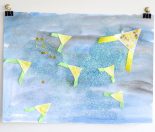
For the preschool crowd, water-paint-and-glitter star art is exactly the right level of mess and reward. Three-year-olds can absolutely do this with help — the glitter alone holds attention for the whole project.
The kids’ book The Seven Kites of Matariki by Calico McClintock pairs beautifully with this craft. Read it before you start, then let the children paint a kite for each star.
9. Blue star glitter slime

Ages 4+ · Materials: PVA glue, contact lens solution, baking soda, blue food colouring, star glitter.
If you have a preschooler who finds the story of Matariki abstract, slime is the universal language. Blue star glitter slime is exactly what it sounds like, and it’s hard to overstate how delighted small children are by it.
The slime itself becomes the night sky. Mixed into the blue base, the silver and gold star glitter swirls when stretched. Pair it with a simple version of the Matariki story and the abstract becomes tactile.
Linking the craft to the meaning
Matariki crafts work best when they’re paired with even a small amount of the story. Otherwise it’s just art hour with a Pacific theme.
The cluster of stars has seven main visible whetū, each with its own name and meaning. Children find the names surprisingly easy to remember when each one is tied to something concrete in their own lives.
- Matariki — the central star, associated with reflection, hope, and the wellbeing of people.
- Pōhutukawa — the star connected to those who have passed in the year just gone.
- Waitī — associated with fresh water and the creatures that live in rivers and lakes.
- Waitā — associated with the ocean and the food it provides.
- Waipuna-ā-rangi — associated with the rain.
- Tupuānuku — associated with food grown in the earth.
- Tupuārangi — associated with food from the sky — birds and elevated berries.
- Ururangi — associated with the winds.
- Hiwa-i-te-rangi — the wishing star, where children send their hopes for the year ahead.
A simple ritual: as you hang each star on the wall hanging (craft #6), or paint each star on the southern lights project (craft #1), name it. That naming is what transforms a craft into a Matariki experience.
A note on pronunciation: if you’re unsure how to say the star names, the official Matariki Festival website has free audio recordings. Saying the names with the right vowel sounds matters — and modelling that respect for your children matters even more than getting it perfect.
More Matariki inspiration
- A free seven sisters of Matariki star printable from diyThought is a lovely starting point for younger children.
- Author Toni Rolleston-Cummins reads The Seven Stars of Matariki on YouTube — a 10-minute read-aloud that pairs with the paint-and-glitter craft.
- Te Papa publishes a free Matariki waiata (song) that families can listen to and learn together.
- For the wider story of the holiday, our companion piece on Matariki and the Māori New Year covers the full background.
Frequently asked questions
When is Matariki 2026?
Matariki 2026 is observed as a public holiday on Friday 20 June. Most schools and whānau celebrate across the week before and the week after that date. Future dates are announced by the Tāhuhu Mātauranga Matariki Advisory Group several years ahead.
What’s the easiest Matariki craft for preschoolers?
Paint and glitter star art is the easiest entry point — children as young as three can do it with help, and the glitter holds their attention for the whole project. Blue star glitter slime is the runner-up. Both use materials most NZ families already have at home.
What’s a meaningful Matariki craft for older children?
Weaving a harakeke whetū (flax star) is the most culturally meaningful option for children aged 8 and up. Building a delta kite is the most memorable hands-on project, and ties to the traditional manu tukutuku (kite) practices of some iwi during the Matariki period.
Why do Māori celebrate Matariki?
Matariki marks the Māori new year and is a time for three things: remembering loved ones who have died in the past year, celebrating the present moment with whānau, and setting hopes for the year ahead. It became a national public holiday in Aotearoa New Zealand in 2022.
How many stars are in Matariki?
The traditional teaching recognises nine stars in the Matariki cluster, each with its own name and meaning. Western astronomy calls the same cluster the Pleiades and identifies seven main stars visible to the naked eye. Both numbers are widely used.
What is Hiwa-i-te-rangi?
Hiwa-i-te-rangi is the wishing star within the Matariki cluster. By tradition, this is the star where children and families send their hopes and wishes for the year ahead. Many Matariki celebrations include a quiet moment for naming wishes — a beautiful family ritual to attach to any of the star crafts above.
Where can I see Matariki in the night sky?
Matariki rises just before dawn in mid-to-late June in New Zealand. Look to the north-east horizon, low in the sky, about an hour before sunrise. The cluster is small but distinct — a tight knot of stars between the constellations Taurus and Orion. Best viewed away from city lights.
What materials do I need for most Matariki crafts?
Most of the crafts on this list use materials you likely already have: paper, paint, glue, glitter, recycled jars and tin cans, ribbon, and string. The only project requiring specialist materials is the harakeke flax weaving — and even that can be substituted with craft-shop dried flax.
Have fun celebrating Matariki with your family, and let us know how your crafts turn out. For more on the holiday itself, read our companion guide to Matariki and the Māori New Year. For hundreds more craft ideas, browse our full creative arts and crafts section.


Hello, this is great, thanks for sharing! Pls note the typo on the constellation name -it should read Pleiades 🙂
Thank you, typo noted, and updated! 🙂